

The Ultimate Guide To Digital Ads For Lead Generation Campaigns In 2026
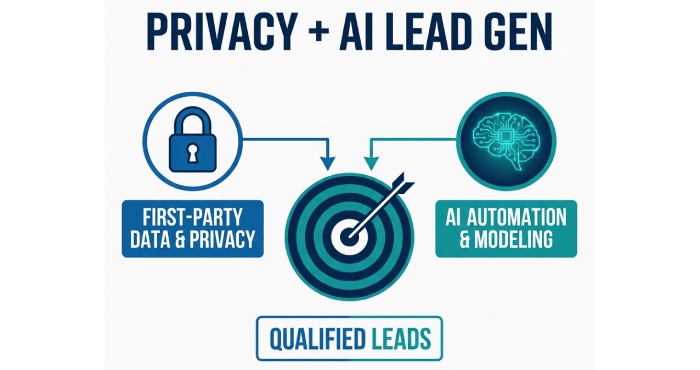
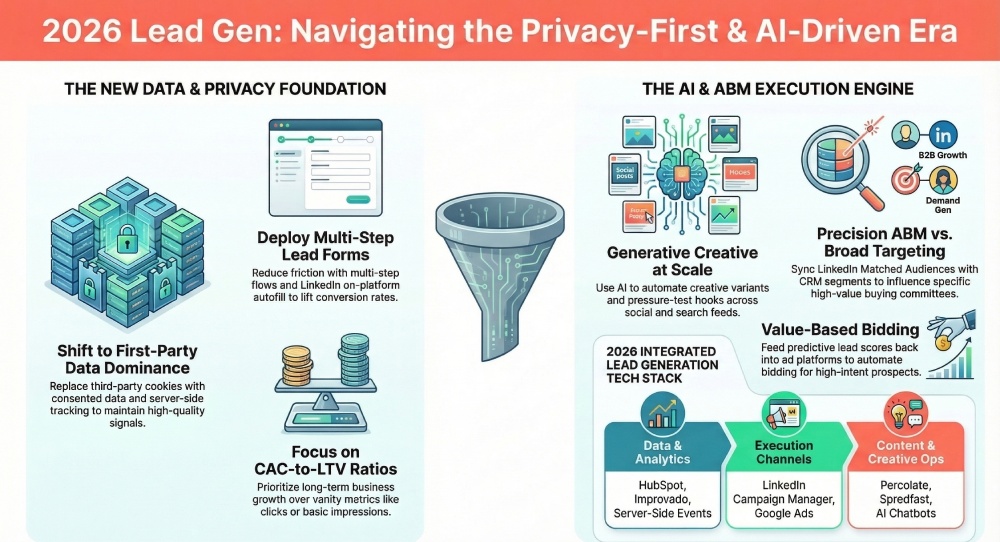
In 2026, digital advertising for lead generation is evolving rapidly as privacy regulations, AI-driven automation, and changing consumer expectations reshape how marketers reach and convert prospects. Traditional tracking methods are fading due to stricter consent requirements and the decline of third-party cookies, forcing businesses to rely more heavily on first-party data, smarter targeting, and privacy-compliant measurement.
At the same time, advanced AI tools are transforming campaign management by optimizing bidding, generating creative variations, and predicting which audiences are most likely to convert. This guide explores how modern marketers can adapt their digital ads strategies—covering channels like search, social, video, and native advertising—while leveraging account-based marketing, advanced analytics, and optimized landing experiences to consistently generate high-quality leads and build a stronger sales pipeline in a privacy-first advertising ecosystem
The 2026 digital ads landscape: privacy shifts, AI, and what they mean for lead gen
Privacy, signal loss, and policy updates
Cookies, consent, and platform policies
By 2026, privacy-first policies are the default across the ad ecosystem. Third-party cookie deprecation, app tracking transparency, and consent-driven data collection compress cross-site visibility and limit granular identifiers. For lead generation, this shift forces marketers to prioritize first-party data, clear value exchanges, and compliant tracking. It also changes how digital ads are optimized: fewer individual-level signals mean heavier reliance on modeled insights and on-platform conversion tracking that protects user privacy while still supporting lead generation campaigns.
AI-powered buying and creative at scale
How automation reshapes digital ads and conversion rates
AI now touches the entire media lifecycle: forecasting, creative versioning, and bid automation. Dynamic ad systems optimize inventory across pay-per-click auctions, social feeds, video, and native placements in real time. Generative creative tools output multiple variants to pressure-test hooks, while algorithms align spend to the highest predicted conversion rates among available targeting options. Guardrails—frequency caps, brand safety, and exclusion logic—keep brand visibility high without eroding customer retention.
What this means for lead generation campaigns
First-party-centric growth and ABM precision
The net impact: high-performing lead generation depends on consented data, sharper segmentation, and account-based marketing motions that influence decision-makers within high-value accounts. Expect more ABM campaigns coordinated between marketing and sales, with unified messaging across LinkedIn ads, search pay-per-click, sponsored content, and message ads. Teams that operationalize these marketing strategies with rigorous analytics and precise tracking consistently generate more qualified leads and healthier pipelines.
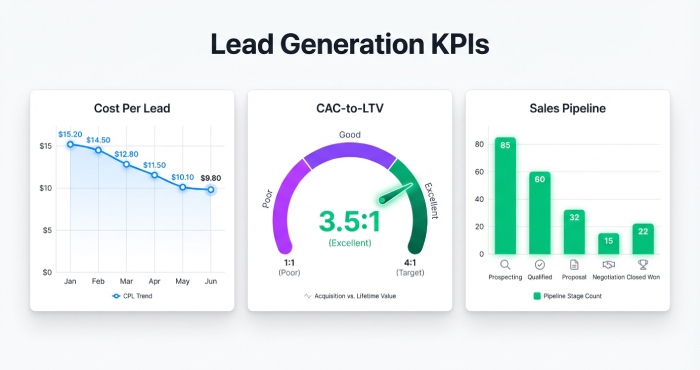
Defining goals, ICPs, and success metrics (CPL, CAC-to-LTV, sales-qualified pipeline)
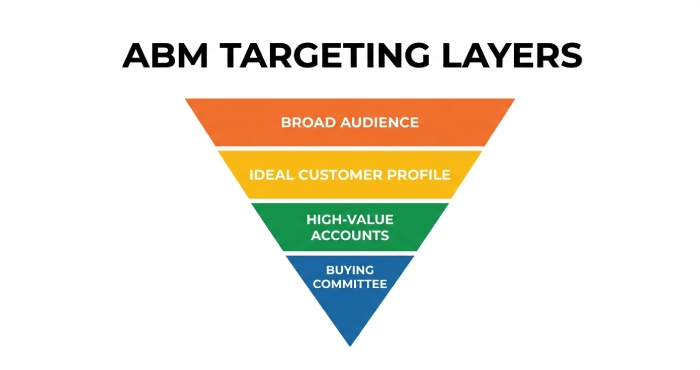
Clarify ICPs and high-value accounts
Align account-based marketing and buying committees
Start with a crisp Ideal Customer Profile: industries, firmographics, buying power, and professional demographic data. Map decision-makers and influencers to ensure your target audience reflects the actual buying committee. For B2B digital marketing, this foundation powers ABM campaigns that deliver account engagement, stronger inbound inquiries, and better resource allocation. When your target audience is explicit, creative and channel choices compound into qualified leads instead of vanity clicks.
ABM campaigns require orchestration
- Coordinate outreach with Sales Navigator lists and CRM segments.
- Sequence sponsored content and message ads before precision outreach.
- Set thresholds for a marketing-qualified lead and a sales-accepted lead so handoffs are unambiguous.
Success metrics and precise tracking
The financials that steer lead generation
Define non-negotiable KPIs tied to business growth:
- Cost per lead (CPL) targets by segment and channel.
- CAC-to-LTV ratios by product and sales cycle length.
- Sales-qualified pipeline and website conversions originating from digital ads.
Measurement design: analytics and attribution modeling
Pair platform-side conversion tracking with server-side events to keep signal quality high. Use attribution modeling that balances pay-per-click intent with assisted influence from LinkedIn ads and content syndication. Centralize analytics for real-time reporting so campaign manager workflows can act fast on engagement metrics and conversion optimization opportunities.
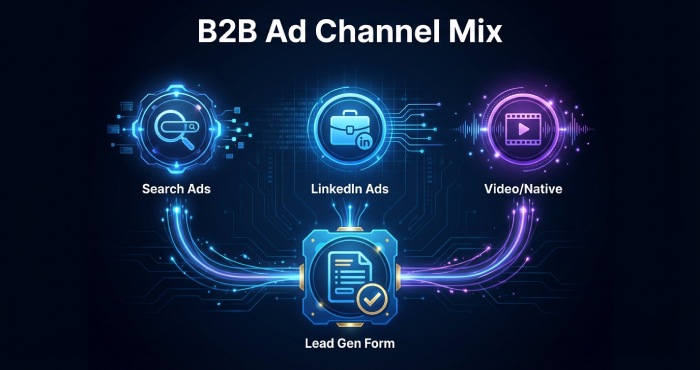
Choosing channels and formats: search, social, video, native, and high-intent lead forms
Search and pay-per-click fundamentals
Capture existing demand with precision
Search remains the backbone of high-intent lead generation. Structure pay-per-click in Google AdWords (now Google Ads) with:
- Long-tail keyword targeting to reach niche markets and late-stage researchers.
- Tight match types and negative terms for efficient marketing efforts.
- Landing experiences optimized for speed, clarity, and conversion rates—especially when routing to high-intent lead gen forms.
LinkedIn ads for B2B demand
Formats and features that turn attention into qualified leads
For complex, multi-stakeholder deals, LinkedIn ads provide unmatched professional demographic data and custom targeting. In Campaign Manager, combine:
- Sponsored content to educate and warm the target audience with thought leadership.
- Message ads for direct-response offers to drive lead generation campaigns with urgency.
- Lead Gen Forms (LinkedIn Lead Gen Forms) to shorten friction and boost qualified leads with on-platform autofill. Augment with dynamic ads, text ads, and Matched Audiences to retarget website visitors and expand reach among lookalike accounts. Plan creative that aligns with ABM campaigns so decision-makers at high-value accounts see a connected narrative from first touch to form fill.
Scale reach while protecting brand visibility
Use audience targeting and frequency controls to expand to a broad audience without waste. Layer custom targeting, seniority filters, and industry attributes to prioritize buying power and reduce irrelevant impressions. Maintain consistent naming and UTM hygiene so conversion tracking stays reliable across sponsored content, message ads, and lead gen forms.
Video, native, and content syndication
Build authority and harvest demand
Short-form video and native placements add upper- and mid-funnel reach while feeding lead generation via retargeting. Pair educational explainer videos with native articles and content syndication partnerships on third-party platforms. Offers like case studies, whitepapers, and eBooks perform best when mapped to stage in the customer journey and supported by clear CTAs in message ads and sponsored content.
Harmonize intent signals across formats
Ensure your SEO strategy and search campaigns echo the same value propositions as social and native. This continuity raises engagement metrics and increases downstream conversion rates when prospects finally meet your lead gen forms.
Targeting in a privacy-first world: first-party data, modeled audiences, and contextual
First-party and modeled audiences
Rebuild signal with owned data and platform tools
Leverage CRM segments from HubSpot, enrich with Sales Navigator, and upload to LinkedIn’s Matched Audiences for custom targeting that respects privacy. Use on-platform modeled audiences to scale from niche markets to a broader lookalike universe without losing alignment to your target audience. Prioritize high-value accounts and known decision-makers while maintaining coverage for net-new discovery.
Contextual and intent alignment
Meet prospects where relevant content lives
Contextual placements grounded in topics and keywords remain resilient. Use Semrush and Ahrefs to identify contextual categories and content partners that mirror your ICP’s research patterns. Blend contextual with first-party retargeting to re-engage site visitors, then progress them to sponsored content and message ads that highlight next-step offers. This layered approach supports conversion optimization even as third-party identifiers fade.
Tighten the loop with retargeting
Retarget website visitors using first-party events tied to scroll depth, asset downloads, or pricing-page visits. Feed these signals back into campaign manager workflows so optimized campaigns prioritize users closest to becoming a marketing-qualified lead.
Offer and creative strategy: value props, hooks, UGC, and thumb-stopping video for leads
Offers that create qualified leads
Lead with proof, specificity, and risk reversal
For B2B buyers, credibility converts. Anchor offers in concrete value: ROI calculators, implementation timelines, or expert briefings. Reference respected sources such as Gartner, the Salesforce Advertising Index Report, and DemandWave research to reinforce claims. Package insights in whitepapers, eBooks, and case studies, then promote via sponsored content to educate and message ads to harvest demand through lead gen forms.
Creative that stops the scroll and speeds decisions
- UGC and customer clips that speak to outcomes lift engagement metrics.
- Thumb-stopping video hooks in the first two seconds improve conversion rates for both broad audience discovery and ABM campaigns.
- Social proof from recognizable brands (for example, enterprise manufacturers like Samsung SDI) builds trust among decision-makers evaluating vendors.
Testing and iteration at scale
Systematize learning across channels
Adopt a data-driven approach: predefine hypotheses on value props, thumbnails, and CTAs; isolate variables; and rotate winners into always-on digital ads. Use analytics and real-time reporting to spot fatigue and adjust targeting options quickly.
Operational excellence for creative
- Use campaign manager and LinkedIn Campaign Manager to coordinate tests across sponsored content, message ads, dynamic ads, and text ads.
- Standardize naming conventions for precise tracking across pay-per-click, video, and native.
- Localize and personalize creative segments to deliver personalized marketing aligned to each step of the sales cycle.

Tooling, partners, and workflows for 2026 lead generation at scale
An integrated stack for measurement and orchestration
Connect media, data, and content operations
A resilient stack underpins modern lead generation campaigns:
- Channels and execution: LinkedIn (Campaign Manager, Lead Gen Forms, Matched Audiences), Google AdWords for pay-per-click, and native/content partners.
- Data and analytics: HubSpot for lifecycle management, Improvado for cross-channel aggregation, and platform conversion tracking for on-platform attribution modeling.
- Content ops: Percolate and Spredfast streamline asset governance and distribution across sponsored content and social placements.
- Partners: Motimatic as a marketing partner can extend reach in education-like funnels; selective content syndication with vetted third-party platforms expands exposure. This setup enables ROI measurement, better resource allocation, and faster optimization loops that drive business growth.
Thought leadership, examples, and team enablement
Learn from practitioners and align cross-functionally
Follow practitioners like Chris Bolman and Heather Hildebrand for modern marketing strategies, and leaders such as Kyung-Heon Kim for perspectives on enterprise scaling. Train sales on fast follow-up Serivce Level Agreements so every marketing-qualified lead transitions to a sales-accepted lead with minimal lag. Maintain playbooks that clarify when to use sponsored content, message ads, and lead gen forms across ABM campaigns aimed at high-value accounts. With disciplined audience targeting, clear targeting options, and coordinated account-based marketing, your digital ads will consistently turn attention into qualified leads.
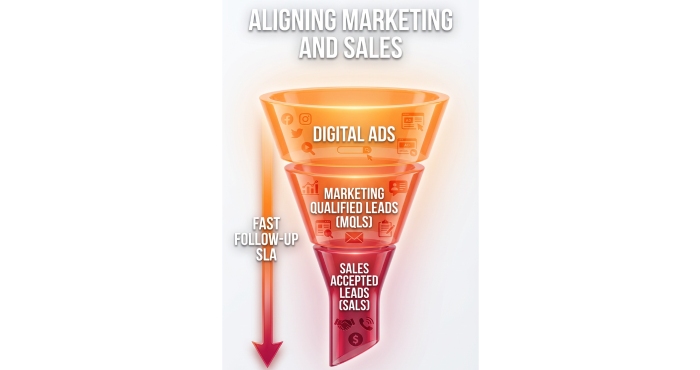
Landing pages and forms that convert: multi-step flows, chat, enrichment, and trust signals
Design micro-friction: multi-step flows and progressive profiling
Multi-step flows reduce perceived effort and are especially effective for lead generation campaigns that reach a cold or broad audience. By splitting fields across steps and revealing value (e.g., a preview of a whitepaper or eBook) after the first click, you preserve momentum and lift conversion rates without sacrificing data quality.
For ABM campaigns targeting high-value accounts, progressive profiling in lead gen forms allows you to collect essentials up front and enrich later touches based on account engagement and the customer journey. Automated follow-up emails can also be sent through Nureply to nurture prospects, personalize communication, and guide potential buyers smoothly through the next stage of the conversion funnel.
When to deploy multi-step vs single-step
- Single-step forms perform well for inbound inquiries and brand-aware decision-makers who respond to message ads or sponsored content with clear intent.
- Multi-step flows shine for digital ads focused on awareness, where marketing strategies favor lowering friction for the target audience before asking for firmographic fields.
Field strategy for lead gen forms
Start with business email and company name, then gate sensitive details behind trust signals. Leverage LinkedIn Lead Gen Forms for auto-fill using professional demographic data, and sync to HubSpot or your CRM to streamline follow-up on qualified leads. Test short vs. long variants by segment to optimize conversion rates across LinkedIn ads and pay-per-click landing pages.
Conversational capture: chat and chatbots
Chat and chatbots can shorten the sales cycle by qualifying in real time. Deployed alongside sponsored content and message ads, conversational widgets can route prospects to the right SDR based on targeting options like industry and buying power.
Routing and qualification logic
Use rules that mirror your account-based marketing tiers: high-value accounts go to senior reps, while SMBs get automated scheduling. Add score thresholds aligned to marketing-qualified lead and sales-accepted lead definitions to enable precise tracking and conversion rate optimization.
Integrations with LinkedIn Lead Gen Forms and HubSpot
Trigger chat playbooks when a visitor submits Lead Gen Forms or arrives from LinkedIn ads UTM tags. Pass fields to HubSpot for enrichment, and use Sales Navigator with Matched Audiences to retarget website visitors who engaged in chat but didn’t convert on-site.
Enrichment and trust signals
Enrichment reduces form fields while maintaining the data needed for lead generation. Append company size, revenue, and technographics to qualify leads from a broad audience without inflating friction. Pair this with strong proof to build confidence.
Data enrichment, professional demographic data, and validation
Tap professional demographic data from LinkedIn to validate titles and seniority, and enhance with third-party platforms like Improvado for analytics pipelines. Apply validation rules to keep junk out, maintaining list hygiene and resource allocation for optimized campaigns.
Social proof: case studies, whitepapers, eBooks and badges
Showcase case studies, client logos, and analyst quotes (e.g., Gartner) near CTAs. Offer whitepapers and eBooks co-branded with a trusted marketing partner to reinforce credibility. Reference outcomes, such as Samsung SDI’s ABM lift with LinkedIn ads and sponsored content, to anchor expectations for business growth.
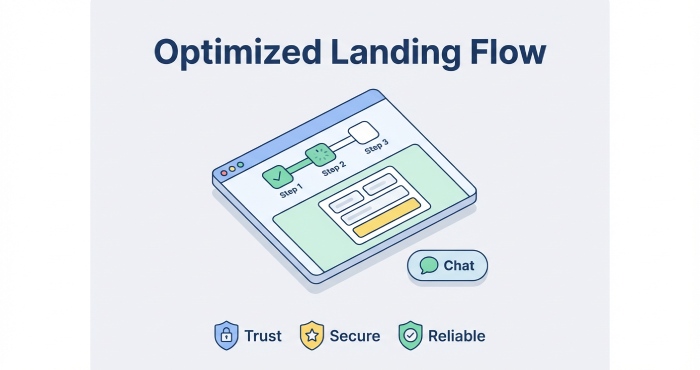
Bidding, budgeting, and scaling: value-based optimization, pacing, and portfolio strategy
Bidding frameworks for pay-per-click and social
Value-based bidding aligns spend with outcomes—not just clicks. Use weighted values for conversion tracking events (e.g., MQL = 1x, SAL = 4x) in pay-per-click and LinkedIn ads to prioritize qualified leads over volume. This data-driven approach elevates lead generation efficiency and supports sustainable marketing strategies.
Value-based bidding and lead scores
Feed predictive lead scores back into Campaign Manager and Google AdWords. Optimize to downstream signals like website conversions and pipeline value, not just form fills. This approach improves return on investment(ROI) measurement across lead generation campaigns and increases conversion rates among your target audience.
Budget pacing and flighting for ABM campaigns
ABM campaigns benefit from tiered budgets: over-invest in high-value accounts during peak research periods and conserve during low-intent windows. Use dayparting and audience targeting to focus on decision-makers when engagement metrics historically spike.
Portfolio strategy across channels: LinkedIn ads, Google AdWords, and text ads/dynamic ads
Balance sponsored content, message ads, and dynamic ads for scale, while text ads and long-tail keyword targeting capture niche markets via search. Blend brand visibility and capture tactics, then reallocate budget weekly using real-time reporting and attribution modeling from platforms like Improvado.
Scaling guardrails
Set frequency caps to protect brand visibility and customer retention while you scale. As you expand targeting options, maintain ABM segments with custom targeting via Matched Audiences and lookalikes, and retarget website visitors to harvest demand created by upper-funnel digital ads.
Broad audience vs niche markets and long-tail keyword targeting
Scale from niche markets into adjacent segments once CPL and SAL rates stabilize. In search, use long-tail keyword targeting to preserve efficiency; in social, expand through similar decision-makers while maintaining account-based marketing exclusions to prevent waste.
Measurement and attribution: server-side tracking, offline conversions, and incrementality
Conversion tracking foundations
Reliable measurement underpins all lead generation campaigns. Implement first-party, server-side tracking to reduce signal loss from browsers and improve precise tracking across digital ads and pay-per-click sources.
Server-side tagging and precise tracking
Route conversion events through server endpoints for better data fidelity, then sync to Campaign Manager and Google AdWords. Leverage UTM governance and Semrush/Ahrefs insights to align SEO strategy with paid insights for comprehensive analytics.
Offline conversion ingestion and CRM alignment
Send CRM-qualified events—marketing-qualified lead, sales-accepted lead, meeting set, opportunity created—back to platforms. This closes the loop so LinkedIn ads, sponsored content, and message ads optimize to actual revenue drivers.
Marketing-qualified lead to sales-accepted lead mapping
Define gated stages and SLAs with sales to reduce leakage. Use Salesforce Advertising Index Report and DemandWave benchmarks to validate stage conversion rates, then benchmark ABM campaigns to ensure high-value accounts are advancing as intended.
Incrementality and attribution modeling
Run geo or audience holdouts to measure incremental lift across targeting options and channels. Compare single-touch models to data-driven attribution modeling for a realistic view of the customer journey.
Experiment design and real-time reporting
Use Campaign Manager’s real-time reporting to monitor tests, but evaluate with cohort windows that match your sales cycle. Incorporate Improvado for cross-channel dashboards and Motimatic or Percolate/Spredfast for creative ops visibility.
Automation and AI: campaign ops, dynamic creatives, predictive lead scoring, and chatbots
Campaign ops automation in Campaign Manager and beyond
Automate bulk edits, bid rules, and pacing across ABM campaigns. Use scripts and APIs to pause underperforming ad sets and scale winners in near real time, maintaining optimized campaigns for your target audience without manual overhead.
Dynamic ads, sponsored content, and message ads variations
Deploy dynamic ads to personalize creative by industry or role using professional demographic data. Rotate sponsored content and message ads variants to test angles for lead generation—product demos, case studies, and eBooks—and lift conversion rates.
Predictive models and lead scoring
AI-driven models evaluate fit and intent signals from account engagement, content consumption, and site behavior. Feed scores into value-based bidding for digital ads, prioritizing qualified leads and improving resource allocation.
Using analytics to forecast website conversions and customer journey outcomes
Blend analytics from HubSpot, Ahrefs, and Semrush to anticipate demand surges and adjust budgets. Predictive insights guide personalized marketing sequences that nurture buying power across the sales cycle and drive business growth.
Conversational AI for qualification and customer retention
Chatbots triage questions, schedule meetings, and enrich profiles in real time. Train them on case studies, FAQs, and compliance rules so they escalate sensitive queries, preserving trust while accelerating lead generation and customer retention.

Compliance and governance: consent, data quality, TCPA/GDPR/CCPA, and platform policies
Consent and preference management
Capture explicit consent within lead gen forms and message ads; mirror those preferences across email, SMS, and third-party platforms. Maintain auditable logs for TCPA/GDPR/CCPA and route suppression lists programmatically to protect marketing efforts.
Platform policy alignment with LinkedIn and third-party platforms
Adhere to LinkedIn and Campaign Manager policies on audience targeting, sponsored content disclosures, and data use. Coordinate with marketing partner legal teams to ensure content syndication partnerships and custom targeting via Matched Audiences meet platform standards.
Data quality, enrichment, and governance
Institute field validation, deduplication, and periodic re-permissioning to maintain list integrity. Leverage enrichment and Sales Navigator insights to confirm decision-makers before routing to sales, improving the odds of qualified leads.
Combatting bot traffic and ensuring brand visibility integrity
Use CAPTCHA alternatives, server-side verification, and IP throttling. Monitor engagement metrics and sudden spikes via analytics to spot anomalies, protecting ROI measurement and safeguarding ABM campaigns from invalid traffic.
Regional regulations and risk mitigation
Document data flows, retention windows, and subprocessors; perform DPIAs where required. Train teams on policy updates and platform changes—citing guidance from experts like Chris Bolman, Heather Hildebrand, and Kyung-Heon Kim—to ensure compliant, scalable lead generation campaigns.

FAQs
How do multi-step forms improve lead generation performance?
They reduce perceived friction and let you collect essential information first, then enrich later. This often lifts conversion rates while preserving data quality for qualified leads.
What bidding model works best for LinkedIn ads in B2B?
Value-based bidding aligned to MQL, SAL, and opportunity values performs best. Optimize sponsored content and message ads to downstream metrics, not just clicks or form fills.
How do I connect offline conversions back to digital ads?
Upload customer relationship management(CRM) events like meetings set or opportunities created into Campaign Manager and Google AdWords. This enables platforms to optimize toward real revenue outcomes and improves attribution modeling.
When should I use dynamic ads vs. text ads?
Use dynamic ads to personalize creative at scale for ABM campaigns and high-value accounts. Text ads are efficient for search intent and long-tail keyword targeting that captures niche markets.
What are the key compliance steps for lead gen forms?
Capture explicit consent, honor regional laws (TCPA/GDPR/CCPA), and synchronize preferences across systems. Maintain logs and align with platform policies on data handling and audience targeting.

How can AI help qualify leads faster?
Predictive lead scoring prioritizes high-fit accounts while chatbots gather context and book meetings. Feeding these signals back into bidding creates optimized campaigns and better resource allocation.
What tools help with measurement and reporting?
Use server-side tracking, Improvado for cross-channel analytics, and Campaign Manager for real-time reporting. Tie in HubSpot or your CRM for offline conversion tracking and ROI measurement.
Key Takeaways
- Use multi-step lead gen forms, enrichment, and trust signals to lift conversion rates while maintaining data quality for qualified leads.
- Apply value-based bidding and tiered budgets across LinkedIn ads, pay-per-click, and ABM campaigns to scale efficiently.
- Close the measurement loop with server-side tracking, offline conversions, and incrementality tests for accurate attribution modeling.
- Automate campaign ops and leverage AI for dynamic creatives, predictive lead scoring, and chat to accelerate the sales cycle.
- Maintain strict consent, data governance, and platform policy compliance to protect brand visibility and long-term business growth.