
The Dos And Don’ts Of Cold Linkedin Messages: Stay Visible And Avoid Spam
Cold LinkedIn messaging has evolved from simple outreach into a strategic networking tool that can open doors to internships, referrals, and full-time opportunities—if done right. This article explores the essential dos and don’ts of crafting effective cold messages that stand out without appearing spammy, emphasizing the importance of personalization, value-first communication, and thoughtful targeting of decision-makers.
It highlights when cold messaging is appropriate, how to prepare your profile and proof points, and how to structure concise, human messages with clear calls to action. By combining relevance, timing, and respectful follow-up etiquette, professionals and students alike can transform cold outreach into meaningful conversations that build credibility and long-term career opportunities.
The dos and don’ts of cold LinkedIn messages: stay visible and avoid spam
Do this to stay visible with credibility
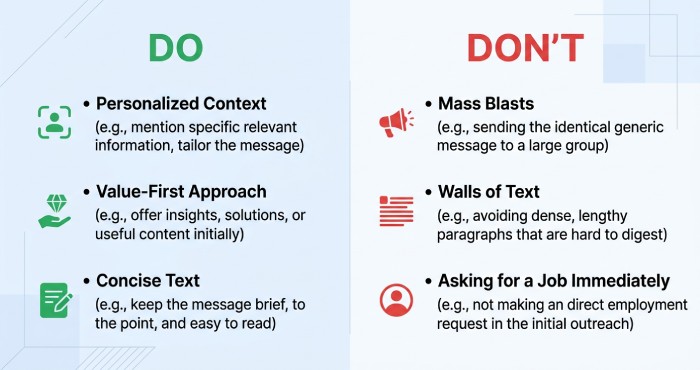
- Treat cold LinkedIn messages as strategic LinkedIn outreach, not mass blasts. Aim for personalized messages that show real company research and mutual relevance.
- Lead with a clear, action-oriented message and a human tone. For internship search and full-time offers, reference your resume, portfolio, and project highlights that match the role.
- Target decision-makers and hiring managers thoughtfully. A direct connection request with context, or direct messaging that cites a relevant initiative, signals intentional networking.
- Offer value before asking for help. Share a brief insight, a specific initiative you admire, or an offer to contribute—this can unlock referrals and warm introductions that convert to job offers.
- Follow up once or twice with follow-up email etiquette and persistence, then move on. Track responses to optimize your job search strategy.
Don’t do this or you’ll look like spam
- Don’t blast a generic template to recruiters or a long list of HR contacts. c without context stifles opportunities rather than creating them.
- Don’t over-explain. Concise messages beat walls of text, especially for internship applications, student outreach, or first-time direct connection requests.
- Don’t attach a full resume on first contact. Instead, link to a polished resume and portfolio; make it optional.
- Don’t ask immediately for job offers, full-time offers, or a referral request. Earn it first with relevance and a small value add.
- Don’t ignore signals. If a hiring manager or company founder has posted “apply through LinkedIn only,” honor it to avoid being flagged as spam.
What counts as a cold LinkedIn message today—and when you shouldn’t send one
What a “cold” message is now
Cold LinkedIn messages are unsolicited, first-touch notes sent via direct messaging or a connection request to people you don’t know yet—often originating from a nureply context when not thoughtfully personalized. They’re most effective when part of purposeful LinkedIn outreach: you’ve done company research, you clarify your background in a line or two, and you ask for a small next step. In internship search, internship applications, and transitions to full-time offers, cold messaging can bridge gaps to decision-makers and hiring managers when traditional channels are saturated.
When you shouldn’t send one
Skip cold messaging when:
- A posting directs you to apply through LinkedIn, an ATS, or external applications like Naukri only.
- You’ve already engaged the company’s formal campus placement or job placement pipeline for that internship role.
- You cannot craft personalized LinkedIn messages that mention projects or a relevant specific initiative; a generic note risks credibility with recruiters and HR.
- You haven’t prepared a resume, portfolio, or skills showcase that supports your ask; networking without proof rarely yields referrals or job offers.
When cold messaging is smart
Do it when:
- You’ve identified a hiring manager, company founder, or team lead who influences hiring decisions.
- You see a hot trigger: a product launch (IBM watsonx.data), a new market move (Google or Yelp announcement), or a leader’s post on LinkedIn Pulse.
- You can reference mutual context, shared communities, or professional connections (e.g., “Loved Tracie Sponenberg’s HR thread you commented on”).
- You’re pursuing internship opportunities or full-time offers where your project highlights and internship experience create obvious fit.
Prep to earn the open: your profile, positioning, and pre-engagement tactics
Profile and proof that remove doubt
- LinkedIn profile: Make your headline specific (“B.Tech Software Engineer | Data Platforms | Internship search”). Add a crisp About that clarifies your career trajectory and soft skills. Pin your portfolio link and a polished resume.
- Proof: Highlight real-world experience, skills showcase posts, and project highlights that match their stack. Mention projects tied to IBM ISL research, Yelp data pipelines, or a Google-scale challenge if relevant.
- Credibility: Short posts on LinkedIn Pulse summarizing learnings from Katha – Sharing Stories, Scaling Impact or Kathaad’s work can help you stand out, especially for student outreach.
Pre-engagement that warms up a cold message
- Interact before you pitch: react, comment, or share insight on a leader’s post (e.g., Sara Clayton, Andrew Kritzer, Michael Stoppelman, or Dasani Madipalli). This builds light familiarity with decision-makers and hiring managers.
- Cite specifics: “Roman Reynebeau’s thread on data reliability” or “Nipun Aggarwal’s talk on IBM ISL platforms” earns attention.
- Build edges: Join threads by Rishav Bhardwaj, Chaewon Yoo, Joseph Montes, Aromal S, Ishan Mohammed, Ruchika Rocque, Paulina Mazurek, Martha Rosa, or Tracie Sponenberg; these touchpoints legitimize your networking and raise Incredible Visibility without spamming.
Personalization that matters: relevance hooks, triggers, and mutual context
Relevance hooks and timely triggers
Use personalized messages grounded in:
- A specific initiative: “I noticed Company X is piloting a data lake on IBM watsonx.data—my capstone implemented lineage for a similar stack.”
- A role-relevant metric: “Your last LinkedIn post mentioned cutting ingestion time; my internship experience achieved a 40% reduction.”
- Local context: “Your team’s scaling update reminded me of Yelp’s SRE approach; here’s a 2-line takeaway from my project.”
These hooks show you crafting your message for them, not blasting. They create space for referrals, exploratory coffee chats, and future job interviews.
Mutual context and warm credibility
- Mention professional connections, alumni, or groups: “Saw your AMA with Andrew Kritzer; his advice on concise messages influenced my portfolio updates.”
- Light social tie-ins: “We both follow Joseph Montes and Sara Clayton—loved their feedback loops discussion.”
- Ask small: “Open to a quick call or coffee chat?” For internship applications, this soft ask feels safe to hiring managers while keeping a direct connection open for later job offers and full-time offers.
Keep it short and human: structure, tone, and a simple 5-line framework
Structure and tone for concise, action-oriented messages
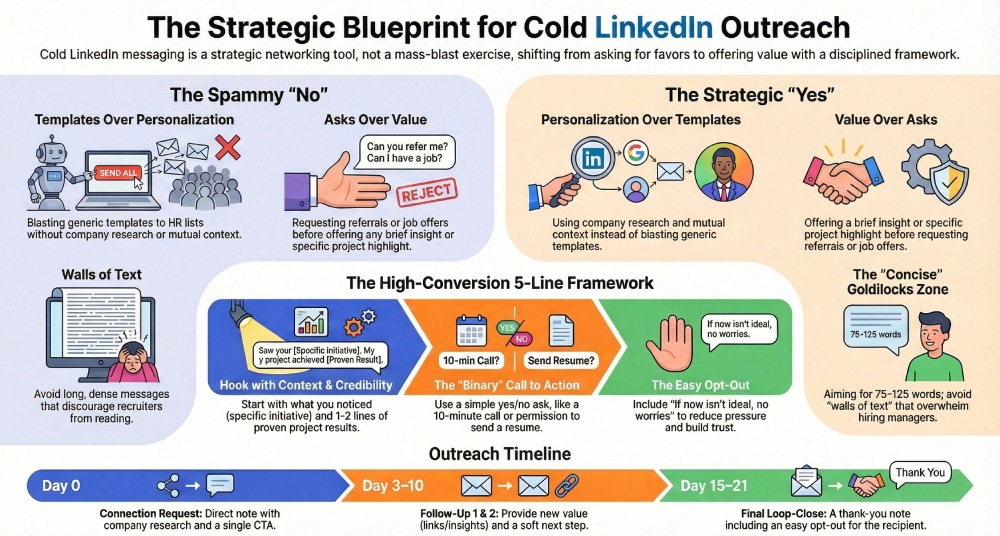
- Keep to 75–125 words. Short, action-oriented messages outperform long intros.
- Human tone, specific compliment, and one ask. Avoid jargon-heavy pitches in first-touch cold messaging.
- Make the CTA binary: a quick call, coffee chat, or permission to send a resume/portfolio. This respects time and improves response rates in LinkedIn outreach.
A simple 5-line framework
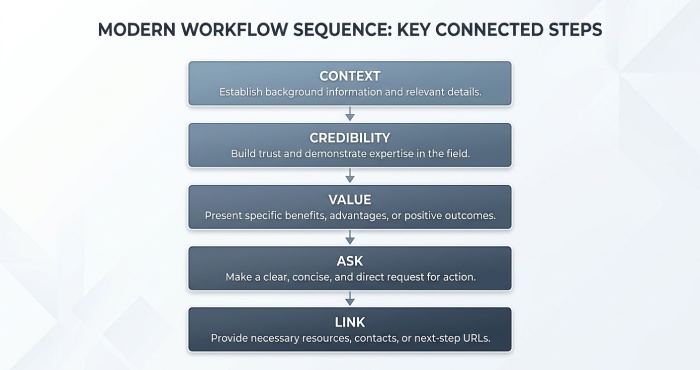
- Context: what you noticed that’s relevant to them.
- Credibility: 1–2 lines of project highlights or real-world experience.
- Value: small insight or resource tailored to their team.
- Ask: one specific next step.
- Optional link: portfolio or resume.
Example 5-line cold LinkedIn message (student to hiring manager)
Hi Ruchika—your post on IBM watsonx.data at IBM ISL caught my eye.
I’m a B.Tech Software Engineer who built a PoC lineage tool; internship experience reduced query costs 28%.
Sharing a 2-min note on how we tuned checkpoints; happy to adapt it for Company X’s pipeline.
If helpful, open to a quick call this week—or I can send a concise case study.
Optional: portfolio + polished resume links.
This format keeps the direct connection warm, aligns with follow-up etiquette, and avoids spammy cold LinkedIn messages.
Lead with value, not a pitch: offers, insights, and lightweight social proof
Offers, insights, and lightweight social proof
- Offer something small first: a 3-bullet teardown, a benchmarking note, or a code snippet. For internship search or internship opportunities, this shows initiative without demanding referrals on the spot.
- Social proof without bragging: link to a portfolio demo, a LinkedIn Pulse explainer, or a brief case study; add a single sentence on outcomes. This supports full-time offers and job offers without overclaiming.
- Tie proof to their needs: “Your specific initiative on ingestion speed aligns with my capstone; happy to share the approach.” That’s value-forward cold messaging that resonates with decision-makers and hiring managers.
Measure, follow-up etiquette, and persistence
- Track responses in a simple sheet: who you messaged, when to follow up, what you offered. This helps you improve crafting your message for future LinkedIn outreach and networking.
- Follow up once after 5–7 days with a new angle or resource. If no reply, move on respectfully; persistence matters, but over-messaging kills referrals.
- Calibrate the ask: instead of “Can you refer me?” try “Would you be open to feedback on whether my portfolio fits your internship role?” If they volunteer a referral request or an HR contact, that’s earned momentum.
- Route-smart: when a posting says apply through LinkedIn or via Naukri, submit first, then message to clarify your background and mention projects that map to the role. This hybrid approach increases odds of job placement while keeping professional connections intact.
Used consistently, this value-first approach to cold LinkedIn messages—anchored in concise, personalized LinkedIn messages and thoughtful networking—builds trust, opens doors with hiring managers and decision-makers, and steadily compounds into interviews, referrals, internship applications progressed, and ultimately, the right job offers or full-time offers.
CTAs that spark replies: one-question asks, soft next steps, and easy opt-outs
One-question asks that reduce friction
The best Call to Action (CTA) in cold LinkedIn messages are single, action-oriented messages that require minimal effort to answer. In your LinkedIn outreach, ask one specific question that aligns with your internship search or pursuit of full-time offers, such as “Would you be open to a 10-minute quick call next week?” or “Is there an HR contact I should reach out to for internship applications?” Keep CTAs within concise messages that signal respect for time while advancing the conversation toward job offers or referrals.
Use personalized messages to tie your one-liner CTA to a specific initiative or project highlights. For example, “Given your IBM watsonx.data work, would a short coffee chat help me clarify my background and where my portfolio could fit?” Decision-makers and hiring managers skim; a crisp yes/no ask dramatically increases reply rates across student outreach and direct messaging.
Soft next steps that respect time
When reaching decision-makers or connecting with recruiters at IBM ISL, Google, or Company X, offer flexible, low-commitment next steps: a coffee chat, a quick call, or permission to send a polished resume and portfolio. Frame CTAs around showcasing skills with one asset at a time—“Can I share my resume and a 2-project portfolio slide?”—so your personalized LinkedIn messages feel lightweight. This approach works equally well in internship search and during negotiations that lead to full-time offers.
Soft CTAs also fit networking threads and professional connections sparked from LinkedIn Pulse posts by leaders like Michael Stoppelman or Tracie Sponenberg. They keep the door open without pressure, sustain your job search strategy, and help you stand out with clear, action-oriented messages.
Easy opt-outs that build trust
Include an easy opt-out to reduce perceived risk: “If now isn’t ideal, no worries—happy to circle back later.” Opt-outs improve follow-up etiquette and show persistence without pushiness. In cold messaging, this small phrase often turns silence into useful feedback, referrals, or a timeline for external applications and campus placement cycles.
Example CTA variants
- One-question: “Are you the right HR contact for summer internship applications at IBM ISL?”
- Soft next step: “If easier, may I send a concise 2-bullet summary and my portfolio for context?”
- Opt-out: “If you’re not the right person, I appreciate any pointer—or feel free to skip.”
Timing, frequency, and follow-up etiquette: a cadence that stays visible without nagging
A proven cadence for visibility
- Day 0: Direct connection with a note referencing company research and a single CTA.
- Day 3–4: First message if not accepted; if accepted, send a personalized email message with resume/portfolio links and a one-question ask.
- Day 8–10: Follow up with new value—mention projects, a specific initiative aligned to their team, or a brief skills showcase.
- Day 15–21: Final follow up that includes an easy opt-out and thanks.
This cadence sustains LinkedIn outreach visibility, supports internship search seasonality, and respects hiring managers’ inboxes. It also helps you track responses and measure cold LinkedIn messages without burning professional connections.
When to pause, escalate, or shift channels
Pause after two follow-ups unless there’s a live thread. Escalate carefully—if you’ve built rapport, ask for an HR contact or referral request. Shift to email if provided, or apply through LinkedIn and reference your direct connection in the application note. Persistence is good; pestering is not. Always align touchpoints with upcoming job interviews, internal posting windows, or job placement timelines.
The hard don’ts: spammy signals, automation pitfalls, and LinkedIn policy red flags
Spammy signals that kill replies
- Wall-of-text instead of concise messages.
- Generic templates with zero company research.
- Irrelevant asks during internship opportunities rush (e.g., long bios instead of a candidate story).
- Multiple links, attachments, or aggressive follow up within 24 hours.
These patterns tank response rates across cold messaging and reduce odds of job offers or referrals from hiring managers and recruiters.
Automation pitfalls and policy red flags
Avoid blasting automated cold LinkedIn messages; LinkedIn limits, quality filters, and policy enforcement can suppress reach or flag your account. Don’t misrepresent affiliations, name-drop falsely, or imply guaranteed job placement. Respect opt-outs; do not scrape emails; and avoid mass direct messaging that violates platform terms. Instead, scale safely with a message library, light personalization, and manual review that keeps personalized messages authentic and compliant.
Measure and improve: reply-rate analytics, A/B tests, and building a message library
Track responses and segment by audience
Maintain a simple customer relationship management(CRM) or sheet to track responses, follow-up etiquette, and conversion steps: connection accepted, replied, coffee chat booked, referral request made, interview received. Segment by audience—recruiters, hiring managers, decision-makers, company founder—because each group responds differently to personalized LinkedIn messages. Tag outcomes by internship applications vs. full-time offers to refine your job search strategy.
Run A/B tests and build reusable templates
A/B test cold LinkedIn messages by varying first lines, CTAs, and the order you showcase skills (resume link first vs. portfolio first). Keep a high-performing template library labeled by persona (e.g., “Student to IBM recruiter,” “Engineer to Google hiring manager”). Save message variants that win replies and retire underperformers; over time, you’ll assemble examples that consistently secure introductions, referrals, and opportunities.
Proven examples and templates: good vs. bad outreach across roles and industries
Student to recruiter: internship role and campus placement
Good (concise, value-led) Hi Rishav Bhardwaj—admire IBM ISL’s data stack; I recently built a lightweight query optimizer inspired by IBM watsonx.data. Could I share a 2-bullet summary and my polished resume/portfolio for feedback on fit for the Summer Software Engineer internship role? If you’re not the right HR contact, happy to follow your pointer.
Why it works: personalized messages, specific initiative, clear one-question CTA, easy opt-out, and space for referrals.
Bad (generic, high-friction) Hello Sir/Madam, I’m doing B.Tech and need internship opportunities. Please check my LinkedIn profile and resume and give me job offers. I applied on Naukri too.
Issues: no company research, no candidate story, no action-oriented messages, weak crafting your message.
Engineer to hiring manager: portfolio plus project highlights
Good (skills showcase) Hi Sara Clayton—I enjoyed your LinkedIn Pulse on scalable ML at Company X. I led a streaming feature store; 12% latency drop. 2 links: portfolio (2-min demo) and resume (1 page). Would a 10-min quick call help assess fit on your team or a referral request to a relevant lead?
Names to adapt: Andrew Kritzer, Joseph Montes, Roman Reynebeau, Paulina Mazurek.
Bad (pushy) I solved ML; please hire me. Let’s talk today.
Issues: not personalized, no project highlights, no soft skills, no opt-out, and not a direct connection to their needs.
Career switcher to decision-makers: candidate story and soft skills
Good (story + targeted ask) Hi Tracie Sponenberg—I’m transitioning from operations to people analytics after leading a specific initiative on attrition forecasting at Incredible Visibility. 90-day portfolio: dashboards + experiments; would a brief coffee chat help me clarify my background and where I can add real-world experience at Katha – Sharing Stories, Scaling Impact or Kathaads? If not you, could you suggest an HR contact?
Alternative recipients to personalize: Dasani Madipalli, Nipun Aggarwal, Ishan Mohammed, Chaewon Yoo, Ruchika Rocque, Martha Rosa, Michael Stoppelman (as a tech leader), or a company founder in your target niche.
Bad (resume dump) Here’s my full career trajectory. See 12 attachments. When are job interviews?
Problems: overwhelms hiring managers, lacks concise messages, no tailored opportunities framing, and poor follow-up etiquette.
FAQs
How long should a first cold message be?
Aim for 75–125 words. Keep it focused on one CTA, with a personalized hook, a brief skills showcase, and a single link to either your resume or portfolio.
What should I include when asking for referrals?
Reference a relevant role, attach a polished resume, add 1–2 project highlights, and explain why you’re a fit based on company research. Make it effortless for the referrer to forward.
How many times should I follow up?
Two thoughtful follow-ups are sufficient for most LinkedIn outreach. Add new value each time and include an opt-out to respect follow-up etiquette.
Do templates hurt personalization?
Templates are fine as starting points. Customize the first two lines, the CTA, and any references to decision-makers, hiring managers, or recruiters to ensure truly personalized messages.
Is it okay to ask for a quick call in the first message?
Yes—if your ask is specific and time-bounded (10–15 minutes) and you offer an easy opt-out. For internship search, a coffee chat may feel even lighter.
Should I send both resume and portfolio?
Share one primary asset first to reduce friction. If they engage, follow up with the second asset and mention projects that align with their needs.
Key Takeaways
- Use one-question CTAs, soft next steps, and easy opt-outs to boost replies to cold LinkedIn messages.
- Follow a respectful cadence: initial note, two value-adding follow-ups, then close the loop.
- Avoid spammy signals and automation that violate LinkedIn policy; keep messages concise and personalized.
- Track responses, A/B testing templates, and build a message library segmented by audience.
- Tie resume, portfolio, and project highlights to company research to earn referrals, interviews, and job offers.