Cold Email Subject Line Examples For Saas Founders And SDRs: Data + Templates
Quick Answer
This article, “Cold email subject line examples for SaaS founders and SDRs: data + templates,” is a practical, data-driven guide designed to help SaaS founders, SDRs, and sales professionals improve cold outreach performance through high-impact subject lines and proven email templates.
This article, “Cold email subject line examples for SaaS founders and SDRs: data + templates,” is a practical, data-driven guide designed to help SaaS founders, SDRs, and sales professionals improve cold outreach performance through high-impact subject lines and proven email templates. It breaks down how attention-grabbing subject lines directly influence open rates, response rates, and overall pipeline efficiency in software as a service (SaaS) outbound, while also providing actionable frameworks for personalization, ICP-specific messaging, and follow-up sequencing.
For a broader look at subject line formulas that work across all industries, see our complete guide to cold email subject lines. Backed by industry insights from organizations like Salesforce and research perspectives from McKinsey & Company, the guide highlights what “good” looks like in modern sales prospecting, including brevity, clarity, and relevance across cold email and LinkedIn channels. It also draws inspiration from leading industry conversations at events such as Dreamforce, helping teams move beyond generic outreach and toward trusted-advisor-style engagement that consistently drives higher engagement and conversions.
What this section covers: data + templates for SaaS outbound
This section gives SaaS founders, SDRs, and Sales Professionals a practical library of cold email subject lines, sales email subject lines, and follow-up emails - plus data-backed guardrails. You’ll get subject line examples that grab attention, raise open rates and response rates, and accelerate the prospecting process. We’ll also map personalization tiers, ICP-specific angles for Founders, Sales Leaders, and Ops, and subject line templates that work in real sales prospecting across the email channel and LinkedIn.
Who this is for
- Early-stage Business Owners validating a solution offering and seeking a trusted recommendation or Referral intro
- Venture-backed teams scaling Sales Cloud/Marketing Cloud motions ahead of Q2 or 2H24
- SDR managers upleveling email strategy, improving Opening Rate and click-through while staying out of the Spam Folder
Why subject lines matter in SaaS outbound: open-rate benchmarks and what good looks like
Your subject line is the front door to your email copy. In cold emails, it must grab attention quickly, be timely and relevant, and avoid the spammy cues that tank open rates.
Open-rate benchmarks for SaaS outbound
Benchmarks vary by Industry, list quality, and sender reputation, but current SaaS outbound patterns show:
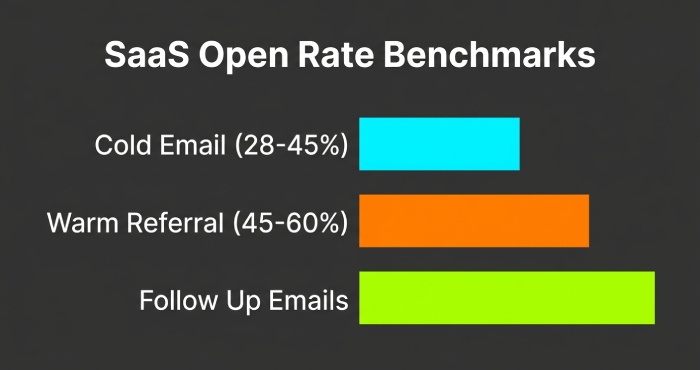
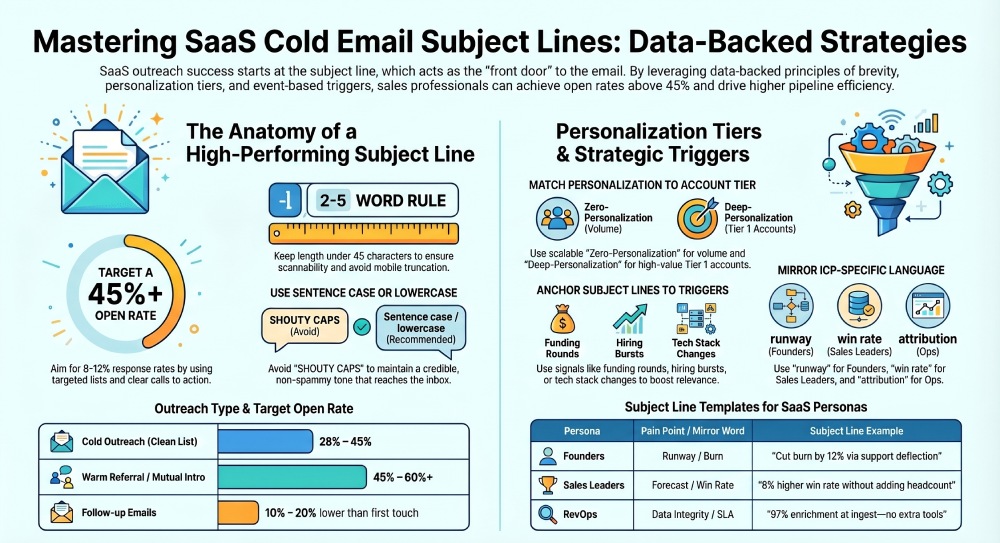
- Cold email Open Rate: often 28-45% with clean lists, clear relevance, and solid deliverability (Email Software, authentication, and domain warmth)
- Warm Referral or mutual connection intros: typically 45-60%+
- Follow-up emails: 10-20% lower open rates than first touch unless the thread is re-energized with a fresh, customized subject line
Salesforce’s State of Sales and McKinsey briefings consistently underline that personalization and relevance boost engagement. Cherilynn Castleman (CGI Executive Coaching) often advises being a Trusted Advisor rather than pushing a sales pitch - your subject line should reflect that.
What “good” looks like
- Open rates above 45% on targeted lists and response rates above 8-12% from subject lines that spark interest and offer help with a clear call to action
- Consistent credibility across channels (LinkedIn, Twitter, Facebook) and events (e.g., Dreamforce) that your Prospect recognizes
- Fast scannability: brevity and subject line length tuned for mobile
Data-backed principles: length, casing, punctuation, numbers, questions, and personalization depth
Length, casing, and brevity
- Aim for 2-5 words or ~25-45 characters; keep it short for mobile. Brevity helps avoid truncation in most Email Software.
- Use sentence case or all lowercase for natural, credible tone. SHOUTY CAPS reduce engagement and risk the Spam Folder.
- One word subject lines can work when the message is laser-precise and context-rich in the body (examples below).
Punctuation, numbers, and questions
- Minimal punctuation - overuse looks salesy. One question mark or em dash is usually enough.
- Numbers make Industry-specific value tangible (e.g., “cut Q2 sales cycle by 17%”).
- Questions convert when tightly aligned to a customer’s problem or business needs.
Numbers
- Use numeric specificity tied to data analysis or benchmarks (e.g., “2H24 pipeline gaps - quick fix?”).
- Reference recognizable timetables (Q2, Q4) or metrics (ARR, CAC) to be attention-grabbing.
Questions
- Make questions problem-solving and outcome-oriented: “Reduce churn in Q2?” vs. “Can we talk?”
- When asking for a Meeting Request, keep the ask light in the subject and put the call to action in the body.
Personalization depth
- Personalization goes beyond the Recipient Name. Tie to role, trigger, or mutual connection.
- Customize around the Company Name, recent industry news, or a trusted recommendation to increase credibility.
Personalization tiers with examples: zero-, light-, and deep-personalized subject lines
Personalization tiers and when to use them
Use deeper personalization for top-tier accounts and lighter for scalable sequences in your outreach. Match the tier to your prospecting process stage and expected deal value.
Zero-personalized (scalable, relevance-first)
Best for volume in early sales prospecting when your ICP is tight and the relevant offer is clear. Subject line examples:
- Cut onboarding time by 30%?
- Churn warning signals - fix in 14 days
- Pipeline hygiene, simplified
- Billing errors, automated
- SOC2 without the headache
Why they work: They grab attention with problem-solving clarity, keep it short, and tee up a tailored solution in the body.
Light-personalized (role, Industry, or trigger)
Add role or Industry cues; light customization without research heavy-lift. Subject line templates:
- {Industry}-ready demos that Sales Leaders finish
- For {Company Name}’s Q2 sales forecast - quick idea
- {Prospect name}, ad spend waste we can stop
- Missed SLAs at {Company Name} - playbook
- {Recipient name}, Marketing Cloud attribution gotchas
These are attention-grabbing and unique subject lines compared with generic sales email subject lines; they spark interest without overpromising.
Deep-personalized (research, mutual connection, or referral)
Use for Tier 1 accounts, executive outreach, or a trusted recommendation. Subject line examples:
- Intro from {mutual connection} re: data onboarding
- {Referral}: {Company Name}’s usage spikes after launch
- Noted your Dreamforce talk - Sales Cloud gaps we can close
- Your Newsletter on renewals - playbook to reduce risk
- Re: {LinkedIn post} - personal solution for {customer’s problem}
These align to the recipient’s language, add credibility, and frame you as a Trusted Advisor rather than pushing a sales pitch.
ICP-specific angles: founders vs sales leaders vs ops - problems, triggers, and language to mirror
Tailor your subject line templates by ICP to raise open rates and response rates. Mirror their pain point, metrics, and key moments.
Founders (Business Owners and startup CEOs)
Common problems: runway, product-market fit, first repeatable pipeline, and fast customer engagement. Triggers: fundraising announcements, Q2 sales targets, new pricing, hiring SDRs, Industry news mentions. Language to mirror:
- “runway,” “burn,” “pilot,” “design partners,” “PMF,” “deal forward” Subject line examples:
- Design partner for {Company Name} - pilot in 2 weeks?
- Cut burn by 12% via support deflection
- First 10 logos from LinkedIn in 30 days
- Ship faster: unblock Marketing Department handoffs
- Referral from {mutual connection} - GTMA idea
Sales Leaders (VP Sales, CRO, Sales Managers)
Common problems: forecast accuracy, rep productivity, ramp, and repeatable sales prospecting. Triggers: Sales Cloud rollout, territory split, QBR findings, low Opening Rate from current sequences. Language to mirror:
- “forecast,” “commit,” “ramp,” “pipeline hygiene,” “win rate” Subject line examples:
- 8% higher win rate without adding headcount
- Reps skipping discovery? 3-step fix
- Q2 forecast: patching stage slippage
- From Dreamforce notes: cleaner Sales Cloud fields
- Mutual connection suggested we talk
Ops (RevOps, Sales Ops, Marketing Ops, CS Ops)
Common problems: data quality, attribution, integrations, and cross-system service level agreement (SLA). Triggers: Marketing Cloud migration, enrichment overhaul, new Email Software, compliance audits. Language to mirror:
- “data integrity,” “enrichment,” “attribution,” “handoffs,” “SLA” Subject line examples:
- 97% enrichment at ingest - no extra tools
- Marketing-Sales handoffs: 5 fields that matter
- Attribution that Finance believes
- SOC2-ready logging in 48 hours
- Referral from {mutual connection} re: routing
<img src=“https://media.mailhop.org/nureply/images/2026/04/generate-inbound-leads-6782.jpg” alt=“ICP Trigger Matrix Table
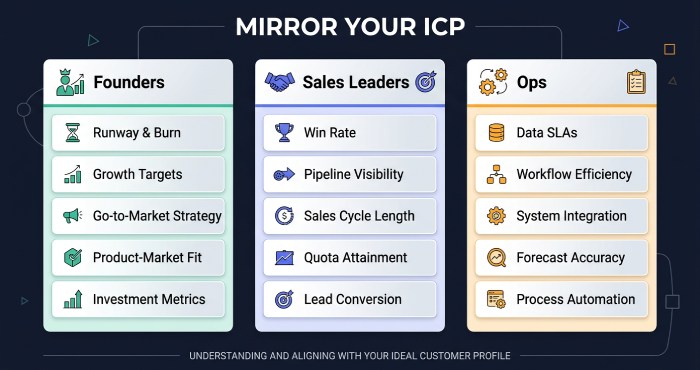
A comparative grid showing the pain points and language to mirror for Founders, Sales Leaders, and Ops.ICP Trigger Matrix Table
A comparative grid showing the pain points and language to mirror for Founders, Sales Leaders, and Ops.” width=“700” height=“370” loading=“lazy” />
Proven subject line templates and follow-ups for SaaS teams
Use this mini-library to operationalize your outreach. Mix and match for cold emails and follow-up emails throughout your prospecting process.
Net-new cold email subject line templates
- {Company Name} <> {your company}: cut churn in Q2
- {Recipient name}, 2H24 pipeline gaps - quick fix?
- AI triage (not ChatGPT) for P1 tickets
- Saw your LinkedIn post - faster demo-to-close
- {Industry} onboarding in days, not weeks
- {Prospect name}, trusted recommendation re: renewals
- Re: {Twitter thread} - personal solution for {customer’s problem}
- Missed calls → meetings booked (Salesforce-native)
- {Company Name} x Sales Cloud: cleaner fields, better forecast
- Compliance without slowing releases
Why these work: they are customized subject line options that keep it short, are timely and relevant, and serve as a clear conversation starter.
Follow-up emails: subject line templates that keep momentum
- Quick nudge on this?
- Worth a chat about {pain point}?
- Closing the loop - helpful?
- Should I close the file?
- Last try: {problem-solving idea} for {Company Name}
- Re: {earlier subject} - new data for you
- Referral angle: Who owns this at {Company Name}?
Follow-up emails benefit from apositive subject line tone and direct call to action to re-open engagement. Use a relevant offer (e.g., short teardown, data analysis, or tailored solution) to bring the deal forward.
One word subject lines (use sparingly)
- Intro
- Idea
- Quick
- Nudge
- Thoughts
These unique subject lines can grab attention, but pair them with a body that demonstrates credibility and a clear solution offering.
Role- and event-triggered templates
- Post-Dreamforce: quick takeaway for {Company Name}
- State of Sales: 3 insights for your team
- {Industry news}: impact on your funnel
- Q2 sales forecast - risk to address now
- 2H24: plan to protect renewal base
Formatting and deliverability guardrails
- Keep subject line length concise; avoid excessive punctuation that can route to the Spam Folder.
- Be specific without hype; attention-grabbing does not mean clickbait.
- Avoid overusing the Recipient and Prospect names; one mention is enough to signal personalization.
- Validate via small A/B tests; measure Open Rate, click-through, and reply conversion - not vanity metrics.
Putting it together: from subject to Meeting Request
Your best sales email subject lines set a Trusted Advisor tone, reflect real personalization, and point to a simple call to action:
- Offer help: “60-second teardown for {Company Name}?”
- Feedback request: “Gut check on your SDR routing?”
- Meeting Request (light): “Worth 10 mins to de-risk Q2 forecast?”
When you cite a mutual connection or a Referral, repeat it in both the subject and first line of the email copy to maximize recognition and customer engagement.
Context and timing: event-, trigger-, and intent-based subject lines
Well-timed cold email subject lines and sales email subject lines are the fastest way to grab attention, drive higher open rates, and lift response rates without changing a single line of email copy. When your subject line examples reflect a clear trigger - funding, hiring, tech stack, or timely industry news - you honor the prospect’s context and reinforce personalization. This timing-first approach strengthens your sales prospecting discipline and shortens the prospecting process.
Event signals: funding, hiring, tech stack, news
Use public events to anchor subject line templates that feel timely and relevant. These signals tell a prospect you did your homework, which boosts credibility and customer engagement.
Funding and hiring cues
- Funding rounds: “Congrats on Q2 raise” or “Series B to scale RevOps?” are subject line examples that grab attention and nudge a Meeting Request. Align your solution offering to the next-stage business needs.
- Hiring bursts: If a Company Name is hiring AEs or engineers, connect to the pain point: “Hiring 10 AEs - ramp faster without more tools?” This speaks to problem-solving and a tailored solution.
Tech stack and product usage signals
- Tech additions or removals on sites like LinkedIn or builtwith: “Salesforce + Sales Cloud + [Your Tool]?” can spark interest because it offers help on a familiar platform. For Marketing Cloud users, try a customized subject line: “[Company Name] + Marketing Cloud: reduce lead leakage?”
Industry news and conferences
- Tie to a major conference or industry news cycle - Dreamforce, a McKinsey report, or Salesforce’s State of Sales. Examples: “Post-Dreamforce follow-up: pipeline gaps I noticed” or “McKinsey data: 2H24 sales productivity playbook.” These unique subject lines are attention-grabbing and position you as a trusted advisor.
Intent data and behavioral triggers
Intent and behavior amplify personalization. When you combine referral context or a mutual connection with recency (visited pricing page, downloaded a whitepaper), your open rates and response rates soar.
Website and content intent
- “Saw you compare [Competitor] vs us - 3-min breakdown?” acknowledges the customer’s problem and provides a personal solution. Pair the subject with a crisp call to action in the body to move the deal forward.
Social and community intent
- “From your LinkedIn post on Q2 sales targets…” or “Heard you on Twitter/X space - quick idea” are conversation starters that keep it short while remaining industry-specific. Reference a post or Newsletter you engaged with to avoid the Spam Folder.
High-performing formulas and templates: 40+ fill-in-the-blank lines for SaaS founders and SDRs
Subject line templates remove guesswork and keep your outreach consistent. Below are 40+ fill-in-the-blank subject line examples designed to grab attention during sales prospecting and improve opening rate and response rates across cold emails and follow-up emails.
40+ fill-in-the-blank subject line examples to grab attention
- “[Mutual connection] suggested I reach out”
- “Referral from [Name] re: [business needs]”
- “[Prospect name], quick idea for [Company Name]’s [team]”
- “Congrats on funding - help with [function] during Q2?”
- “Hiring [role]? 30-day ramp plan for [Company Name]”
- “Saw [tool] in your stack - reduce cost by [X%]?”
- “Post-Dreamforce: [solution offering] for [Industry]”
- “McKinsey stat on [topic] - how it applies to [Company Name]”
- “Salesforce + [Your Product]: faster [outcome]”
- “Fix [pain point] without another sales pitch”
- “Question about [Company Name]’s [metric]”
- “Idea to raise open rates on your Newsletter”
- “Cut SDR time on follow-up emails by [X%]”
- “For your Q2 sales push: [relevant offer]”
- “[Recipient name], permission to share a tailored solution?”
- “How [peer company] solved [customer’s problem]”
- “Trusted recommendation from [mutual connection]”
- “ROI breakdown: [problem-solving] in 2 minutes”
- “If [prospect name] owns [metric], this helps”
- “Noticed [industry news] - impact on [Company Name]?”
- “Your post on LinkedIn inspired a thought”
- “ChatGPT vs humans for [task]? 1 data point”
- “Saw you at [event] - 1 takeaway for [team]”
- “3 ideas to increase response rates this week”
- “Re: yesterday’s click - next step?”
- “Are we the wrong fit for [Company Name]?”
- “Should we stop outreach?” (polite check-in)
- “Last try - [benefit] in 10 minutes?”
- “[2H24] plan: reduce CAC by [X%]”
- “Revenue leaders using Sales Cloud do this”
- “Marketing Cloud users: quick win on [use case]”
- “Time to value in 14 days for [Industry]”
- “Invite: 7-min teardown for [Recipient]”
- “[Meeting Request] to assess [metric]?”
- “Offer help: [Company Name]’s [team] and [pain point]”
- “Your Podcast/Newsletter note on [topic] - thought?”
- “Feedback request on our [one-pager]?”
- “Trusted advisor POV on [trend]”
- “If you still own [goal], this is timely and relevant”
- “Follow-up on our referral from [Name]”
- “Re: your evaluation of [Competitor]”
- “Snooze me if now’s bad - when’s better?”
- One word subject lines: “Idea” / “Quick?” / “Thought” / “Congrats” / “Intro”
- Positive subject lines: “Nice win” / “Well done” / “Appreciate this”
- Attention-grabbing + brevity: “[metric] ↓ by 27%?” / “3 slides?” / “10 mins Tue?”
Use these as subject line templates across the email channel, adapting for customization: add the recipient name, prospect name, or Company Name to tighten relevance and improve click-through rate.
Testing roadmap: A/B design, sample size math, sequencing, and how to read the data
Testing cold email subject lines and sales email subject lines requires discipline. Treat tests like experiments - one change at a time - to isolate what truly improves open rates, opening rate by segment, and downstream response rates.
Designing clean A/B tests
- Control vs variant: Test one variable (e.g., subject line length, presence of recipient name, or mutual connection reference). Keep email copy, timing, and audience constant.
- Segmentation: Split by Industry, persona (Sales Leaders, Business Owners, Sales Professionals), and stage (new cold emails vs follow-up emails) to avoid cross-contamination.
- Sequencing: Test early-sequence cold email subject lines first, then follow-up subject line examples. Early wins compound engagement across the prospecting process.
- Governance: Pre-register hypotheses with your Marketing Department to prevent p-hacking and to ensure credibility when you brief leadership.
Sample size, significance, and reading the data
- Sample math: For baseline 30% open rate and a detectable lift of +5 pts at 90% confidence, target ~900-1,100 Recipients per arm. Smaller lists? Run sequential tests and pool across weeks.
- Primary vs secondary metrics: Optimize for Open Rate first, then click-through and reply Response Rates. A subject line that grabs attention but misaligns with email copy often hurts engagement later.
- Interpreting results: Use simple data analysis - bayesian or frequentist is fine - just be consistent. Read device mix for mobile truncation effects and time-of-day for “timely and relevant” alignment.
Benchmarks: open rates, click-through, response rates
- Cold: 35-55% open rates with high-quality personalization and a customized subject line; 1-5% responses depending on Industry and offer.
- Warm/referral: 50-70% opens when you lead with mutual connection or Referral; 8-15% responses if the call to action is specific.
- Nurture: Newsletter and event follow-ups vary; align to a relevant offer and trusted recommendation to protect credibility.
Deliverability guardrails: spam triggers, preview text, mobile truncation, and sender reputation
Even the strongest subject line examples fail if they never reach the inbox. Protect deliverability so your cold email subject lines can grab attention safely and avoid the Spam Folder.
Avoiding spam triggers and optimizing preview text
- Language: Avoid ALL CAPS, excessive punctuation, and spammy phrases (“FREE!!!”, “Act now”) in sales email subject lines. Keep it short, use brevity without sounding robotic, and match a professional tone befitting a Trusted Advisor.
- Preview text: Pair the subject with preview text that extends the promise: “Re: [mutual connection] - 30s idea on [metric].” This alignment boosts Open Rate and customer engagement.
- Sender reputation: Warm up domains, authenticate Email Software (SPF/DKIM/DMARC), and don’t blast new lists. Aim for consistent outreach volume and a clean unsubscribe.
- Compliance: Honor opt-outs, respect Industry regulations, and coordinate with the Marketing Department to prevent list fatigue across channels like LinkedIn, Twitter, and Facebook.
Mobile truncation and subject line length
- Keep subject line length to ~35-49 characters for mobile scanners; front-load the hook (e.g., “Referral from [Name]: [benefit]”). Test devices and email clients to confirm no key tokens are cut off.
Playbook to operationalize: building a team swipe file, governance, and continuous improvement cadence
Operationalize your email strategy so great subject line templates don’t live in a one-off doc. Create a shared swipe file with categorized subject line examples - referral-led, mutual connection, pain point, industry-specific, problem-solving, one word subject lines, and positive subject lines - tagged by persona and funnel stage, using tools like Nureply to centralize, organize, and reuse high-performing cold outreach assets across teams.
Add a simple rubric: relevance, personalization depth, clarity, and attention-grabbing quality. Encourage Sales Professionals to log wins and losses, plus screenshots of top-performing cold emails and follow-up emails.
Governance matters. Assign an owner (RevOps or enablement) to review performance weekly, retire underperformers, and promote winners. Monthly, run a calibration: compare segments (Sales Cloud users vs Marketing Cloud users; SMB Business Owners vs enterprise Sales Leaders). Bring in external perspective - Cherilynn Castleman of CGI Executive Coaching often advises teams to act as a Trusted Advisor first, seller second. Borrow insights from Salesforce State of Sales reports, Q2 and 2H24 planning cadences, and McKinsey & Company research to keep playbooks timely and relevant.
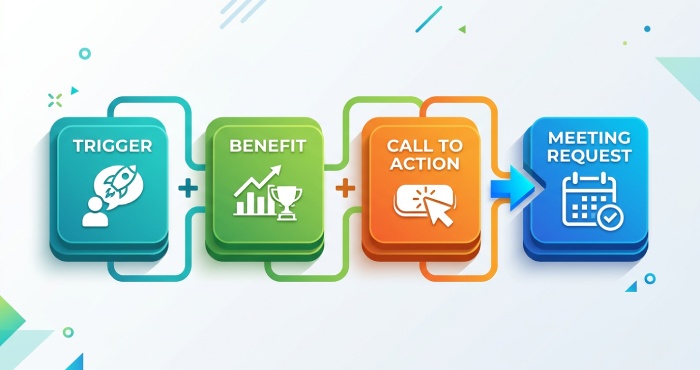
Finally, coach execution: rehearse personalization with a repeatable framework (Trigger + Benefit + Call to Action). Use ChatGPT to brainstorm unique subject lines, then human-edit for customization. Align with your email channel infrastructure and cadence; ensure every rep can map a subject line to a personal solution for the prospect, a clear Meeting Request, and a specific next step that moves the deal forward.
FAQs
How do I decide which triggers to use in my subject lines?
Prioritize triggers closest to revenue impact: funding, hiring, tech stack, and direct intent (pricing page visits). These signals justify outreach, enable personalization, and reliably boost open rates and response rates.
What’s the ideal length for cold email subject lines on mobile?
Aim for 35-49 characters and keep it short by front-loading the hook. Test for mobile truncation to ensure mutual connection or referral cues aren’t cut off.
Should I use the recipient’s name in every subject line?
Use the recipient name or prospect name when it adds clarity or familiarity, but avoid overuse. Personalization must be substantive - tie it to a pain point, industry news, or relevant offer.
How many A/B tests should I run at once?
One at a time per segment. Change only the subject line to isolate impact; hold email copy, timing, and audience constant so your data analysis reflects reality.
Are one-word subject lines effective?
They can be, especially in follow-up emails or when replying in-thread. Use them sparingly and pair with strong preview text to maintain credibility and engagement.
How do I avoid the Spam Folder with attention-grabbing lines?
Steer clear of spammy phrases and excessive punctuation, authenticate your domain, and keep volume consistent. Match the promise in your subject to the body’s call to action and solution offering.
Can I reuse top-performing templates across industries?
Yes - with customization. Adapt subject line templates to the Industry, insert Company Name context, and align to business needs for a tailored solution that sparks interest.
Key Takeaways
- Use event, trigger, and intent signals to anchor cold email subject lines that grab attention and drive higher open rates and response rates.
- Operationalize with a shared swipe file of subject line templates, governance, and a weekly testing cadence across personas and Industries.
- Run clean A/B tests with sufficient sample size; optimize Open Rate first, then click-through and replies for full-funnel gains.
- Protect deliverability by avoiding spam triggers, optimizing preview text, and managing sender reputation to stay out of the Spam Folder.
- Lead with personalization, mutual connection, or referral cues, and align every subject with a clear call to action that moves the deal forward.
Topics
Content Team
The NuReply content team. AI-powered cold email outreach platform by DuoCircle.
Ready to scale your cold email outreach?
AI-powered personalization that gets replies. Start free - no credit card required.