Best Cold Email Checker Tools For Deliverability, Validation, And Spam Testing
Quick Answer
Cold email success in 2026 depends on far more than just hitting “send” - it requires a precise blend of clean data, strong authentication, and optimized content that can consistently reach the inbox. This article explores the best cold email checker tools designed to improve deliverability, streamline email validation, and identify spam risks before campaigns go live.
Cold email success in 2026 depends on far more than just hitting “send” - it requires a precise blend of clean data, strong authentication, and optimized content that can consistently reach the inbox. This article explores the best cold email checker tools designed to improve deliverability, streamline email validation, and identify spam risks before campaigns go live.
By combining advanced email verification, real-time validation, and in-depth spam testing into a unified workflow, modern solutions empower businesses to reduce bounce rates, protect sender reputation, and enhance engagement. For a comprehensive overview of the legal and compliance rules behind cold email, see our cold email compliance and legal guide. Whether you’re scaling outreach or refining campaign performance, understanding how these tools work - and what makes them effective - can significantly elevate your cold email outcomes.
What makes a “best” cold email checker in 2026
Unified coverage across verification, validation, and content testing
The best cold email checker today brings email verification, email validation, and deliverability diagnostics into one workflow. That means it handles email list cleaning and bulk email verification, runs deep email address validation on risky domains, predicts inbox placement, and acts as a template checker that surfaces spam score issues before you launch email campaigns. Modern stacks also provide real-time verification via a reliable real-time API, integrate with CRMs and email marketing platforms, and output a clear deliverability score you can act on to improve email performance.
Why deliverability, validation, and spam testing matter for cold email outcomes
List quality and bounce risk directly shape ROI
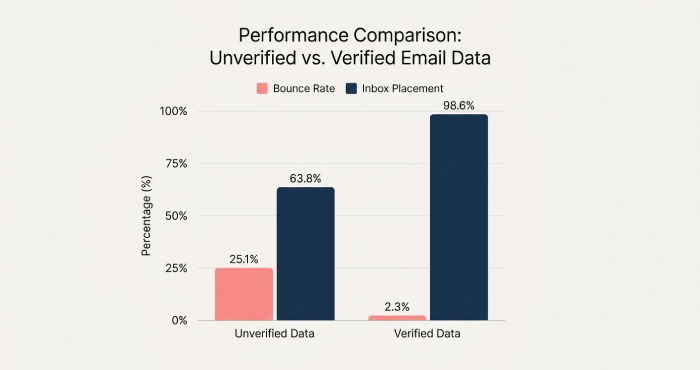
Invalid email addresses and catch-all emails inflate bounce rate, hurt email open rate, and damage email sender reputation. Clean, verified data via a trusted email verifier reduces spam traps exposure, filters out abuse emails and disposable emails, and ensures business email verification is solid before you scale email outreach. Consistent email list cleaning and bulk list cleaning are foundational best practices for cost control.
Reputation and inbox placement determine campaign visibility
Strong email deliverability means most messages reach Gmail, Outlook, and other email service providers’ primary tabs, not Promotions or Junk. Deliverability and domain warm-up, blacklist check monitoring, and sender-auth verification (SPF/DKIM/DMARC) all support inbox placement. A cold email checker that models spam filter behavior and reports a campaign-level deliverability score lets you fix risks proactively.
Content quality steers the spam filter and engagement
A robust template checker will flag spam trigger words, excessive number of links, broken links, and accessibility issues that depress email engagement rates. It guides email template optimization for mobile responsiveness, html validation, and personalization that meets compliance needs. Content that’s readable (balanced word count, question count, reading time) can lift email performance across multiple email campaigns.
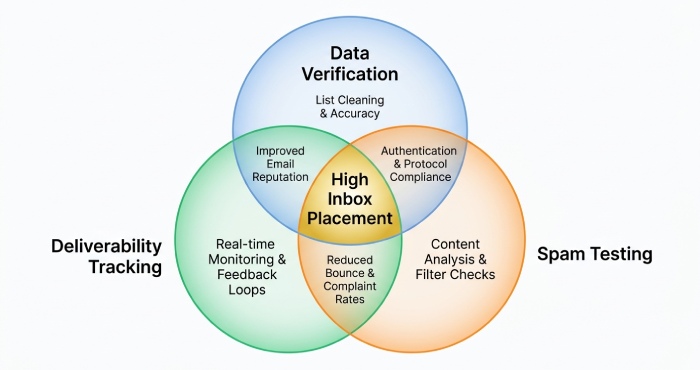
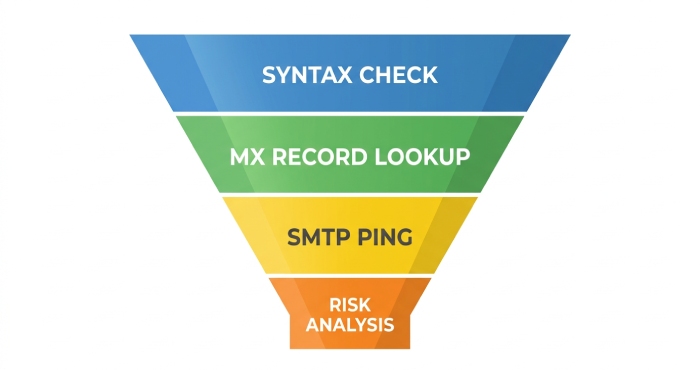
How cold email checkers work: from syntax/MX/SMTP pings to risk signals and inbox placement tests
Syntax checks, MX lookups, and SMTP pings for email address validation
Foundational email validation starts with syntax checks, domain/MX records, and SMTP handshake pings. A capable email verifier inspects role accounts, mailbox existence, temporary server responses, and throttling rules at scale. These steps power accurate bulk email verification and safer real-time verification to gate new signups or form fills on your email list.
Risk intelligence: spam traps, abuse emails, disposable and catch-all domains
A modern cold email checker enriches with risk signals: known spam traps, high-complaint senders (abuse emails), disposable email providers, and domains configured as catch-all emails. Combined scoring and suppression lists help prevent deliverability losses and keep email deliverability trending up across ongoing email campaigns.
Inbox placement tests and template checker diagnostics
Seed-list tests and mailbox panel telemetry simulate inbox placement across Gmail, Outlook, and other email client compatibility scenarios. A good solution pairs those with a template checker that models major spam filter engines and computes a granular spam score.
Email content analysis and HTML validation
Email content analysis checks html validation, CSS inlining, and rendering quirks while recommending email template optimization.
Mobile responsiveness and broken links
Previews and link crawls test mobile responsiveness and catch broken links that reduce trust and click-through.
Subject line checker, spam trigger words, and spam score
A subject line checker audits spam trigger words, excessive punctuation, and capitalization, then rolls findings into an overall spam score you can benchmark against past sends.
Evaluation criteria: accuracy, catch-all handling, speed, integrations, privacy/compliance, and support
Accuracy on catch-all handling and speed at scale
Look for measurable accuracy on catch-all emails and clear handling of greylisted mailboxes. Speed matters - especially for bulk email verification and real-time verification gates. Vendors should publish methodology, sample sizes, and a benchmark of false positives/negatives on business email verification.
Integrations, real-time API, and API reliability
Tight integration with CRMs, email marketing platforms, and bulk email tools is key. SDKs in Python, JavaScript, Ruby, and Rust simplify integration, while high API reliability, rate limits, and latency SLAs matter in production. Consider data enrichment connections (e.g., lusha) and flexible webhooks to your email delivery service.
Privacy, compliance, security, and support
Compliance with GDPR, HIPAA, and CCPA, plus SOC 2 and ISO 27001 certifications, should be table stakes. Some vendors still reference Privacy Shield; verify current frameworks. Network hardening via Cloudflare, robust encryption, and regional data residency are important. Evaluate user docs, migration guides, and human support. Cross-check claims on G2, Capterra, and Trustpilot before you commit.
Tool landscape overview: list verifiers vs deliverability suites vs spam-testing labs
List verifiers for fast, scalable email list cleaning
These tools focus on email verification, email validation, and email list cleaning at scale. They remove invalid email addresses, catch disposable sources, and streamline bulk list cleaning and email address validation.
Deliverability suites with warm-up and monitoring
Full suites add seed testing, domain warm-up or email warm-up, blacklist check tracking, and ongoing inbox placement insights. Many include a template checker module to tune content for major spam filter systems andlift deliverability score.
Spam-testing labs and infrastructure diagnostics
Labs specialize in spam score modeling, blocklist scan depth, authentication checks, and email client compatibility previews. They’re ideal preflight tools before high-stakes email campaigns, complementing your email verifier and bulk email verification routines.
2026 roundup: notable tools and what they’re best for
List verifiers: data quality and bulk processing
- ZeroBounce: Balanced accuracy on catch-all emails with strong abuse emails and spam traps detection, plus a helpful template checker add-on and real-time API endpoints for email address validation.
- NeverBounce and MillionVerifier: Competitive pricing for bulk email verification and high-speed email list cleaning; good for frequent list hygiene prior to email outreach.
- Emailable, BriteVerify, Clearout, DeBounce, Verifalia: Solid email verification coverage with business email verification, disposable detection, and integration options spanning CRMs and email marketing platforms. Many publish user docs and support real-time verification to prevent invalid email addresses at capture.
Deliverability and spam-testing: content, seeds, and diagnostics
- GlockApps, Mail-Tester, and Mailreach: Strong spam filter simulations, seed testing for inbox placement, and spam score breakdowns. Useful as a template checker for email content analysis, html validation, and subject line checker workflows that improve email performance.
- InboxReady/Mailtrap and MXToolbox: Deep protocol diagnostics, blacklist check automation, authentication validation, and monitoring to protect email deliverability and email sender reputation across Outlook, Gmail, and diverse email service providers.
Platforms with built-in checks and warm-up
- Lemlist, Instantly, Apollo: Outreach platforms that embed a cold email checker for list hygiene, basic email validation, and deliverability features like email warm-up and domain warm-up. Handy for teams that want a single UI to manage email campaigns, sequence personalization, and email engagement rates tracking.
Practical ways to boost email performance with a cold email checker
Operationalize checks across data, infrastructure, and content
- Data: Automate bulk email verification and ongoing email list cleaning. Gate new leads with real-time verification and a real-time API. Suppress spam traps, abuse emails, and disposable emails.
- Infrastructure: Monitor deliverability score, DNS/auth health, and run continuous blacklist check scans. Align with your email delivery service and email service providers on sending limits and IP/domain rotation.
Optimize templates with measurable diagnostics
Use the template checker each sprint: review spam score, subject line checker feedback, and email content analysis. Tune word count, question count, reading time, and the number of links. Fix broken links, ensure mobile responsiveness and accessibility issues are addressed, and push incremental email template optimization that aligns with best practices.
Connect results to outcomes and governance
Map verification and spam filter findings to email open rate, reply rate, and pipeline metrics. Report improvements in inbox placement and email deliverability to stakeholders. Ensure compliance reviews (GDPR, HIPAA, CCPA) are part of content and data flows, and document procedures in user docs.
Notes from the field: Teams in SaaS and B2B - think awesomic, motion, quicklizard, userway, seiling, youteam - often integrate verification into CRMs, enriched with sources like lusha, and instrument dashboards to benchmark sender reputation over time. Some leverage Cloudflare for API edge protection and cache, while engineering teams prefer SDKs in Python, JavaScript, Ruby, or Rust for fast integration. Warmy and Anybiz sit in the ecosystem with domain warm-up and outreach utilities that complement a standalone email verifier - use them to precondition new domains and stabilize deliverability before scaling email campaigns.
Step-by-step Workflow: Cleaning, Real-Time Verification, and Interpreting Results
Prepare and Clean Your Email List
- Normalize data fields, deduplicate contacts, and segment by source and intent before any email list cleaning begins. Remove role accounts where appropriate and prioritize business email verification for B2B segments.
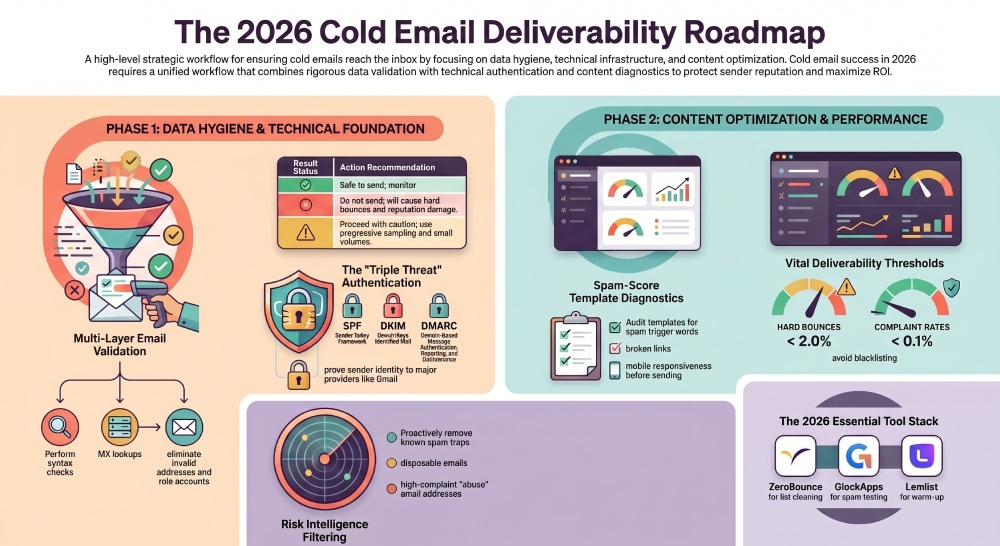
- Run bulk list cleaning to flag spam traps, disposable emails, abuse emails, and catch-all emails. This is the foundation of email validation and reduces the bounce rate that harms email deliverability.
- Use a cold email checker or email verifier that performs syntax checks, mx/dns lookups, and mailbox pinging. Vendors like ZeroBounce and Anybiz can run bulk email verification, while Warmy can be used in parallel for domain warm-up to reinforce inbox placement for upcoming email campaigns.
Run Bulk and Real-Time Verification
- Start with bulk email verification to process the entire email list and output granular statuses. Follow with real-time verification at point-of-capture via a real-time API to keep new records clean and prevent invalid email addresses from entering CRMs or email marketing platforms.
- Evaluate API reliability and ease of integration with common stacks (Rust, Ruby, Python, JavaScript), CRMs, and email service providers. Check user docs for rate limits, webhook callbacks, and error handling to maintain stable email performance at scale.
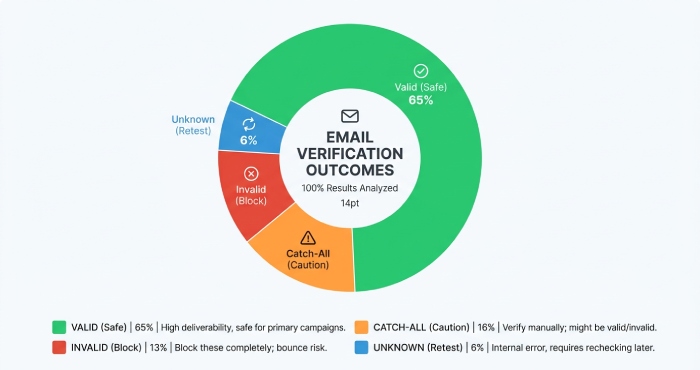
Interpret Valid, Invalid, Unknown, and Accept-All Results
- Map verification outcomes to sending rules that protect deliverability and improve email performance. Incorporate a deliverability score where available, and weight by source quality.
Valid
- Safe to send, but still monitor bounce rate and email engagement rates. Use personalization and best practices in the template checker to sustain inbox placement.
Invalid
- Do not send. Invalid email addresses lead to hard bounces, a damaged email sender reputation, and increased scrutiny from each spam filter across Outlook and Gmail.
Unknown / Accept-All
- Unknown results can occur due to timeouts or greylisting, which temporarily prevent accurate mailbox verification. Accept-all domains respond “OK” for any address, so it’s important to proceed with caution. For catch-all emails, including Nureply type addresses, consider progressive sampling and limit initial sending volumes. Using a cold email checker to monitor spam score and open rate before scaling helps reduce risk and protect your sender reputation.
Spam Testing and Message Optimization
Seed Lists and Inbox Placement Monitoring
- Build a seed list spanning major mailbox providers (Outlook, Gmail) and global regions. Test across multiple email client compatibility scenarios to track inbox placement and spam folder rates.
- Use a cold email checker with a template checker to preview how content renders and whether authentication passes. Correlate inbox placement with email open rate benchmarks to refine email campaigns.
Spam-Score Diagnostics and Authentication Alignment
- Run spam-score diagnostics before launch. Many email verifier suites provide a spam score and spam filter-level detail to show which rules were triggered.
- Scan for spam trigger words, excessive capitalization, and misleading CTAs; use a subject line checker to catch risky phrasing and to tune question count and word count. Keep authentication aligned (SPF/DKIM/DMARC) to improve email deliverability and reduce false positives.
Content and Link Hygiene: Template and HTML Checks
- Use a template checker that performs email content analysis, html validation, mobile responsiveness preview, and link scanning. Check number of links, reading time, and accessibility issues to avoid content patterns that inflate spam score.
- Validate all URLs for broken links and ensure your tracking domain is authenticated. Consistent brand domains and clear unsubscribe language also lower spam filter friction and support compliance.
Link Hygiene and Redirect Discipline
- Keep redirects minimal; host tracking through authenticated subdomains and avoid link shorteners that degrade sender trust.
Technical Foundations: SPF, DKIM, DMARC, Reputation, and Tracking
Authentication: SPF, DKIM, and DMARC
- SPF authorizes sending IPs; DKIM signs message headers; DMARC enforces alignment and reporting. Proper alignment is essential for email address validation signals that mailbox providers use when scoring messages for inbox placement.
- Publish a DMARC policy with rua/ruf reporting to monitor spoof attempts and gradually tighten from none to quarantine/reject as confidence grows.
Domain/IP Reputation and Blocklists
- Reputation is built through consistent sending, low bounce rate, and authentic engagement. Perform a regular blacklist check across major blocklists; if listed, pause volume and remediate quickly.
- Use Cloudflare or similar DNS/CDN for resilient DNS and fast propagation of SPF/DKIM/DMARC updates. Maintain sending consistency to protect your deliverability score and overall deliverability.
Tracking Domain Setup and Sending Infrastructure
- Authenticate a branded tracking domain and align it with your primary domain to avoid mixed-domain signals that raise spam score. Calibrate domain warm-up and email warm-up to ramp volumes gradually.
- Coordinate with your email delivery service or email service providers to fine-tune throttling, concurrency, and retries. A cold email checker integrated into your build process can prevent risky launches for new email campaigns.
Cost and Accuracy Trade-offs
Pricing Models and Vendor Selection
- Common pricing models include per-credit bulk email verification, monthly seat plans, and usage-based real-time verification via a real-time API. Compare vendors like ZeroBounce, Warmy, and Anybiz on G2, Capterra, and Trustpilot for satisfaction, accuracy, and support quality.
- If you operate across multiple email marketing platforms or CRMs, evaluate integration speed, SLA, and auditability. Ensure business email verification coverage is strong for your target verticals.
Sampling Vendors and Running Accuracy Audits
- Run a head-to-head benchmark with holdout segments to validate accuracy. Split your email list across vendors, send controlled volumes, and compare hard bounces, spam score trends, and downstream engagement.
- Track inbox placement, email open rate, and reply/click signals as secondary indicators. Document results and share user docs internally to standardize best practices.
Data Retention Limits and Security Posture
- Confirm data retention policies, encryption standards, and certifications such as SOC 2 and ISO 27001. Align vendor practices with GDPR, CCPA, and HIPAA where applicable, and request details on privacy shield-successor safeguards for cross-border transfers.
- Only store results necessary for ongoing email validation, and purge raw addresses on schedule. Limit access via roles, monitor logs, and enforce least-privilege for all integrations.
Ongoing Hygiene and Compliance
Bounce and Complaint Thresholds; Suppression Lists
- Keep hard bounces well below 2% and complaints below 0.1%. If thresholds exceed targets, pause sending, extend email warm-up, and re-run email verification.
- Maintain global suppression lists for unsubscribes, abuse emails, and risky segments from prior email outreach. Sync suppressions across email marketing and sales systems to protect email deliverability.
Opt-out Handling and Preference Centers
- Provide one-click unsubscribes and process opt-outs within required windows. Offer topic and frequency preferences to reduce complaints and improve email engagement rates.
- Use personalization and email template optimization to send relevant content. A template checker can enforce brand consistency, html validation, and mobile responsiveness to maintain trust.
Legal Considerations: CAN-SPAM, GDPR/PECR
- CAN-SPAM requires accurate sender identity and a functional opt-out; GDPR/PECR add purpose limitation, lawful basis, and data minimization. Document compliance and maintain lawful basis records for EU/UK prospects.
- Align ccpa transparency and do-not-sell/disclose requests with operational workflows. Train teams and audit fields regularly to ensure compliance across email service providers and CRMs.
Practical Notes on Data, Signals, and Tooling
Leveraging External Signals and Ecosystem Tools
- When enriching B2B data via providers such as lusha, screen outputs with an email verifier and cold email checker to minimize risk. For prospect lists referencing brands like awesomic, motion, quicklizard, userway, seiling, and youteam, prioritize email address validation before outreach.
- Use bulk email tools with built-in template checker features and subject line checker modules to monitor spam trigger words, question count, and number of links. This safeguards email campaigns and helps keep spam score low.
Operationalizing with APIs and Pipelines
- Build a verification pipeline in Python or JavaScript for fast experimentation, and port to Rust or Ruby services for production-grade throughput and API reliability. Orchestrate batch jobs nightly and use real-time verification on lead forms.
- Centralize results in your data warehouse to monitor deliverability, inbox placement, and blacklist check outcomes over time, then feed back into segmentation for continuous improvement.
FAQs
What’s the difference between email verification and email validation?
Email verification typically refers to technical checks like DNS, MX, and mailbox pinging, while email validation combines verification with risk scoring and heuristics (e.g., disposable emails or spam traps). Both protect deliverability and reduce bounce rate.
How should I treat accept-all and unknown results?
Treat catch-all emails and unknowns cautiously. Start with small sends, monitor spam score and inbox placement, and promote only those that show positive engagement without raising bounce rate.
Do template checkers really improve deliverability?
Yes. A template checker runs email content analysis, html validation, and mobile responsiveness checks, helping you avoid broken links, spam trigger words, and rendering issues that can increase spam filter friction and lower email performance.
How often should I run bulk email verification on my lists?
Run bulk email verification before any major campaign and quarterly for ongoing hygiene. Pair it with real-time verification at capture to prevent invalid email addresses from entering your systems.
Which metrics best predict inbox placement?
Consistent authentication (SPF/DKIM/DMARC), low bounce rate, and steady engagement (open, click, reply) correlate strongly with inbox placement. Monitor spam score trends and blacklist check status to catch emerging issues.
What security and privacy standards should vendors meet?
Look for security operations center (SOC) 2 and ISO 27001 certifications, clear GDPR/CCPA readiness, and strict data retention limits. Ensure encryption in transit/at rest and strong access controls for all integrations.
Does domain warm-up help new senders?
Yes. Domain warm-up and email warm-up stabilize sender reputation and reduce the chance of landing in the spam filter. Ramp volume gradually and validate lists continuously to protect email deliverability.
Key Takeaways
- Combine email list cleaning, bulk email verification, and real-time verification to minimize bounces and protect deliverability.
- Use seed tests, spam-score diagnostics, and a robust template checker to optimize content and reduce spam filter risk.
- Authenticate SPF, DKIM, and DMARC, and monitor reputation with regular blacklist checks to sustain inbox placement.
- Balance cost and accuracy by sampling vendors, auditing outcomes, and enforcing strict data retention and compliance.
- Maintain suppression and opt-out workflows, and align with CAN-SPAM, GDPR/PECR, and CCPA to keep email campaigns compliant and effective.
Topics
Content Team
The NuReply content team. AI-powered cold email outreach platform by DuoCircle.
Ready to scale your cold email outreach?
AI-powered personalization that gets replies. Start free - no credit card required.