
The Ultimate Guide To Cold Email Automation Tools For Agencies: Features, Pricing, ROI
In today’s competitive B2B landscape, agencies are increasingly turning to cold email automation tools to build scalable, predictable lead generation systems for their clients. From SaaS and B2B services to ecommerce brands, the right combination of email outreach tools and email automation software enables teams to run highly targeted campaigns that book meetings, nurture prospects, and open new markets—without adding manual workload.
When integrated with platforms like HubSpot or paired with reliable sending infrastructure such as SendGrid, these systems can directly connect outreach efforts to pipeline and revenue. However, success depends not just on automation, but on strategy, deliverability, personalization, and compliance. This guide explores the full landscape—from features and pricing to ROI, use cases, and risks—helping agencies choose the right stack and implement cold email programs that scale profitably and sustainably.
Why agencies should automate cold outreach: use cases, client outcomes, and when not to automate
Use cases that scale pipeline and revenue
- Agencies use cold email automation to build consistent lead generation programs for clients in B2B services, SaaS, and ecommerce. With the right email outreach tools and email automation software, teams can run automated email campaigns that book meetings, accelerate partnerships, and warm up new markets.
- Common programs include account-based outreach, webinar and newsletter signup invites, and reactivation sequences timed with product launches. Email sequences and follow-up automation ensure no prospect slips through the cracks, while email campaign management centralizes insights across multiple brands and regions.
- For agencies offering email marketing services alongside ads or SEO, cold campaigns plug directly into sales funnel software and CRM integration to track influenced pipeline and closed-won revenue.
Client outcomes and ROI levers
- ROI compounds when agencies align email sequences to buyer journeys, personalize offer angles, and tune email deliverability. Automated workflows reduce manual hours, enabling higher-margin retainers. Use a simple cost calculator to quantify time saved from tasks like list-building, mail merge, and email tracking.
- Campaign analytics and email performance analytics expose what’s driving meetings: subject-line resonance (use a Subject Line Previewer or subject line tester), reply sentiment, and ICP-fit. A/B testing on offers, CTAs, and responsive email templates steadily improves meeting rates and lowers cost per opportunity.
- Pricing discussions are easier when you pair a Side-by-Side Comparison of ESPs and outreach automation vendors with a Free ESP Comparison Template. Note monthly pricing, trial period, and free trial details, plus any money-saving tips such as annual discounts or free email marketing tools for startups.
When not to automate
- Skip or limit outreach automation when lists are low-intent or scraped without consent, when brand risk is high, or when stakeholders need high-touch, founder-led conversations. Poor fit data will harm email deliverability and deliverability score, hurt domain reputation, and waste spend.
- Avoid bulk email sending to purchased lists; focus on opt-in sources, warm introductions, and intent signals. For complex enterprise motions requiring procurement steps or RFP cycles, use shorter, highly personalized email outreach sent manually.
Must-have features for agencies: sequencing, advanced personalization, account-level permissions, inbox rotation
Sequencing and orchestration
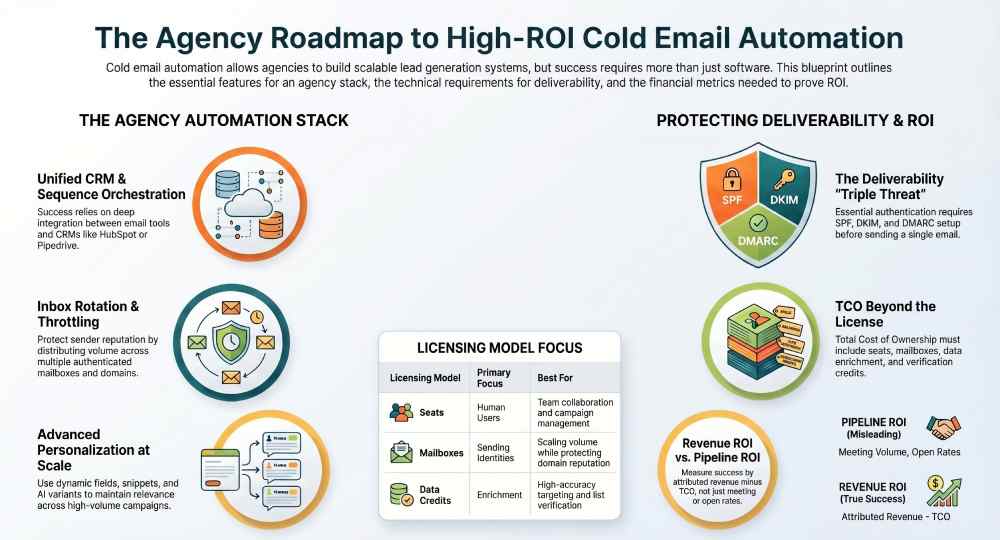
- Look for multichannel email sequences with branching logic, drip campaigns, email scheduling, and SLA-aware follow-ups. Strong email campaign management should allow per-client reporting, template libraries, and shared assets with account-level permissions.
Advanced personalization at scale
- Dynamic fields, snippets, custom variables, and images enable personalized email outreach without sacrificing volume. AI email marketing tools can draft variants, but humans must approve tone and context. Mail merge should support fallback logic and email list segmentation at the contact and account level.
Governance and security
- Agencies need role-based access controls, approval workflows, and audit trails across client workspaces. Contact management must respect subscription management preferences and regional compliance, and support onboarding emails or transactional emails separately via a Transactional Email Service like SendGrid.
Inbox rotation and sending logic
- To preserve email deliverability, systems should support inbox rotation, randomized send windows, warm-up rules, and throttling. Deliverability-aware sending logic, plus email deliverability tools that monitor blocklists, bounces, and spam placements, is essential for sustained lead generation.
Deliverability essentials: domain setup, warm-up strategies, list hygiene, sending logic, bounce/complaint handling
Domain setup and authentication
- Authenticate with SPF, DKIM, and DMARC. Use DMARC Monitoring Tools to spot spoofing and alignment issues. Proper email authentication, subdomain strategy, and consistent From-naming conventions materially improve email deliverability.
Warm-up strategies and ramping
- Gradually scale automated email campaigns by warming new domains and inboxes. Start with low volumes, prioritize highly qualified segments, and test engagement before expanding. Follow email best practices: mobile-optimized emails, plain-text variants, and minimal images to avoid spam triggers.
List hygiene and verification
- Clean lists frequently with reputable email verification tools and suppress risky addresses. Combine intent and enrichment with verification to protect sender reputation. High-quality data plus deliverability-aware email outreach tools yield better replies and pipeline.
Handling bounces, complaints, and reputation
- Auto-suppress hard bounces, track soft bounces, and route complaints to a remediation workflow. Leverage email deliverability tools to monitor placement, IP health, and domain reputation; adjust content and cadence as needed. Campaign analytics should expose deliverability score trends at the client level.
Data and personalization at scale: sourcing, enrichment, intent signals, dynamic fields, snippets, images
Sourcing and enrichment
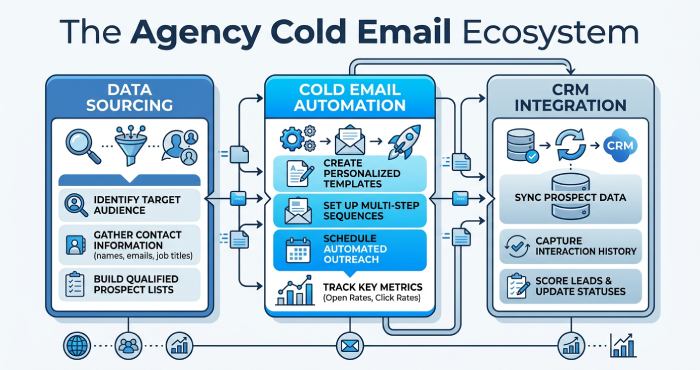
- Build segmentable datasets from CRM, ATS, LinkedIn, and industry guides. Augment with firmographics, technographics, and buying-committee roles. Tie enrichment to CRM integration so records stay consistent across sales funnel software and email marketing services.
Intent and timing
- Use third-party intent, first-party web signals, and product-usage events to time email sequences. Dynamic routing can trigger automated email campaigns after key actions—form fills, newsletter platforms engagement, or ecommerce automation milestones.
Personalization building blocks
- Deploy dynamic fields for role, region, and use case; add snippets for case studies; include images (e.g., personalized screenshots). Keep tone concise, add a clear CTA, and test variants with A/B testing. Pair a Subject Line Previewer with a subject line tester to pre-empt truncation and spammy phrasing.
Integrations and workflow automation: CRM/ATS, calendars, webhooks, Zapier/Make, reporting pipelines
CRM/ATS, calendars, and meetings
- Deep CRM integration with HubSpot CRM, Pipedrive CRM, and EngageBay CRM ensures accurate attribution, deduping, and contact ownership. Calendar integrations eliminate booking friction and let email automation software push meeting outcomes back to the CRM for end-to-end reporting.
Webhooks, Zapier/Make, and automated workflows
- Webhooks and no-code tools (Zapier/Make) tie outreach automation to marketing automation, landing page builders, and email integration with your ESP. This enables automated workflows like: new MQL in HubSpot triggers personalized email outreach; conversion updates CRM stages in sales funnel software.
Reporting pipelines and BI
- Centralize data with reporting pipelines into your warehouse. Blend email performance analytics, campaign analytics, and revenue data to refine audience targeting, budgets, and messaging. Side-by-side comparison dashboards and an email platform comparison help select the best email marketing software for each client.
Vendor landscape notes (ESPs, CRMs, and tools agencies actually use)
ESPs and outreach stack examples
- Agencies often pair ESPs like Mailchimp, ActiveCampaign, Brevo, Omnisend, Klaviyo, MailerLite, ConvertKit, GetResponse, EmailOctopus, Beehiiv, Constant Contact, and Flodesk with dedicated email outreach tools. Evaluate Mailchimp Alternatives if you need more granular email campaign management, or consider Omnisend vs Mailchimp when ecommerce automation is core.
- Many ESPs include responsive email templates, template libraries, and newsletter platforms capabilities; the best newsletter platforms also offer landing page builders, email migration support, and user reviews to validate fit. Verify monthly pricing, the trial period, and any free trial terms.
- For transactional emails and infrastructure, SendGrid remains a common Transactional Email Service; it pairs well with cold email automation when routed through separate authenticated domains.
How to choose for agencies
- Shortlist based on best email marketing software for the client’s stack, the depth of CRM integration, native email verification tools, quality of email deliverability tools, and ability to orchestrate automated email campaigns. Ensure email outreach tools support email sequences, follow-up automation, email tracking, mail merge, email scheduling, and contact management out of the box.
- Use a Free ESP Comparison Template to run a side-by-side comparison across deliverability, outreach automation, automated workflows, email list segmentation, onboarding emails, newsletter signup features, subscription management, and email integration with sales funnel software.
Pricing, ROI, and packaging guidance
- Package services around outcomes: qualified meetings and pipeline generated. Combine email marketing services with email marketing consulting for messaging, positioning, and compliance. Anchor price to impact, but show cost offsets via automation time-savings and improved conversion rates.
- Include money-saving tips such as consolidating under annual plans, leveraging free email marketing tools during pilots, and using a phased rollout. Present an ROI model that accounts for data spend, email deliverability tooling, enrichment, and the lift from the best email marketing software portfolio you deploy.
Quality and compliance checkpoints
- Maintain strict email authentication, opt-out handling, and data provenance to protect email deliverability. Document playbooks with email best practices and create client-facing industry guides that explain cadence, tone, and testing strategy. Keep an eye on DMARC and use DMARC Monitoring Tools to ensure alignment as domains scale.
Bringing it all together
- For agencies, the winning motion blends cold email automation, rigorous email campaign management, and tight CRM integration to power lead generation. Select email automation software that unifies automated email campaigns, robust email sequences, and personalized email outreach—then reinforce it with strong email verification tools and always-on email deliverability tools. Coupled with interoperable sales funnel software and a curated mix of the best email marketing software and ESPs, this stack scales reliably and profitably across clients.
Pricing and total cost of ownership
Seats vs. mailboxes: how licensing impacts your stack
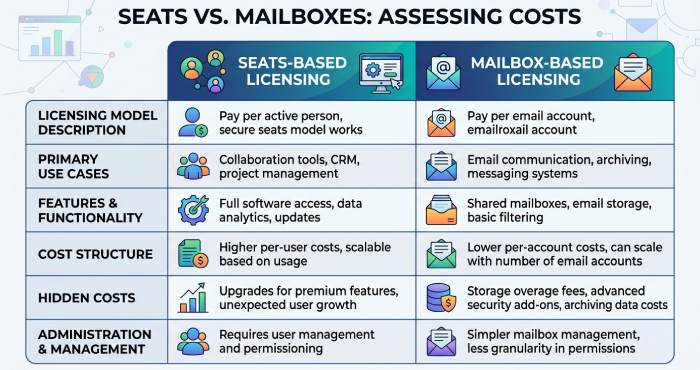
- Seats license human users; mailboxes license sending identities. Cold email automation platforms often price per mailbox because warm-up pools and rotation matter for email deliverability. Traditional email marketing services tend to price per seat for collaboration and email campaign management.
- If your team runs personalized email outreach across SDRs, a per-seat plus per-mailbox model can add up fast. Verify how many login seats you need for sales, marketing, and ops—and how many domains/mailboxes you’ll rotate for automated email campaigns.
- Check whether your CRM integration is included per seat or per account. Some email outreach tools bundle native HubSpot CRM, Pipedrive CRM, or EngageBay CRM connectors at higher tiers.
Sending limits, throughput, and overage traps
- Daily/weekly caps vary by ESP and mailbox provider. Bulk email sending without throttling can crush sender reputation; prioritize controls that pace email sequences and protect email deliverability.
- Ask vendors about pooled IPs vs. dedicated IPs, separate Transactional Email Service lanes for transactional emails, and safeguards like preflight deliverability checks. SendGrid, Brevo, and ActiveCampaign outline throughput policies clearly.
- For outreach automation, confirm how tools handle warm-up, ramp schedules, and follow-up automation limits so campaigns don’t stall mid-sequence.
Data credits, add‑ons, and hidden costs
- Data enrichment, email verification tools, and email deliverability tools are common add-ons. Some platforms sell data credits for validation and enrichment—vital for lead generation but easy to overspend on without a cost calculator.
- Common hidden costs: extra mailboxes, additional domains, compliance add-ons (DMARC Monitoring Tools), advanced email tracking, mail merge personalization at scale, landing page builders, and template libraries.
- Evaluate monthly pricing vs. annual discounts, trial period terms, and free trial limitations. Free email marketing tools can be useful for pilots, but caps on email scheduling, campaign analytics, and email list segmentation can mask true needs.
TCO checklist for leadership review
- Core licenses: seats + mailboxes across marketing and sales.
- Sending: dedicated IPs, domain costs, and warming services to protect email deliverability.
- Data: verification/enrichment credits for accurate targeting.
- Integrations: CRM integration, email integration fees (HubSpot, Pipedrive, EngageBay), webhooks, and custom API usage.
- Services: onboarding emails setup, email migration, email marketing consulting, and training.
- Governance: DMARC, SPF/DKIM setup, and ongoing monitoring.
- Tools overlap: best email marketing software vs. email outreach tools—avoid duplicating email automation software and sales funnel software features.
Calculating ROI
Core formulas and realistic benchmarks
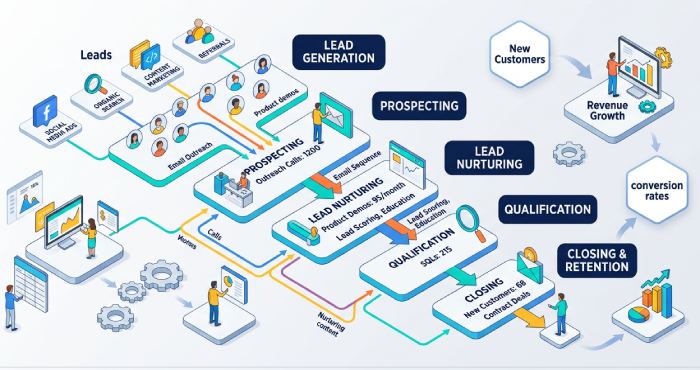
- Pipeline ROI: (Attributed Pipeline − Program Cost) / Program Cost. Tie cold email automation touchpoints to sales funnel software stages: reply, meeting, SQL, closed-won.
- Revenue ROI: (Attributed Revenue − Total Cost of Ownership) / TCO. Include data credits, deliverability add-ons, and services.
- Performance inputs: open rate quality (impacted by email deliverability), positive reply rate from personalized email outreach, meeting rate per 100 prospects, and conversion rate of email sequences to opportunity. Use email performance analytics and campaign analytics to track uplift.
Attribution models that work for email
- First-touch for pure lead generation programs; last-touch for activation pushes; multi-touch for longer cycles blending drip campaigns, newsletter platforms, and automated email campaigns.
- For ecommerce automation (Omnisend, Klaviyo), combine click-based attribution with view-through benchmarks to credit browse/recover flows and transactional emails without double counting.
Client reporting dashboards
- Build dashboards around email campaign management KPIs: deliverability score, domain health, reply quality, opportunity creation, and revenue influenced. Subject Line Previewer and a subject line tester can sit beside A/B testing widgets to show creative impact.
- Surface per-segment performance using email list segmentation and template-level reporting. Tie activities to CRM stages via contact management for trustworthy attribution.
Benchmark sources and validation
- Blend vendor industry guides with third-party user reviews to set targets. Compare cohorts across ESPs like Mailchimp, MailerLite, Constant Contact, GetResponse, and EmailOctopus.
- Run a side-by-side comparison pilot across two vendors (e.g., Omnisend vs Mailchimp) to validate assumptions before full rollout.
Vendor landscape and comparison framework
SMB vs. enterprise tool stacks
- SMB-focused email marketing services and newsletter platforms—MailerLite, Beehiiv, ConvertKit, Flodesk, EmailOctopus—excel at ease of use, responsive email templates, and best newsletter platforms features.
- Enterprise-focused ESPs—HubSpot, ActiveCampaign, SendGrid, Klaviyo, Brevo, Omnisend—offer deeper email automation software, AI email marketing tools, automated workflows, and compliance controls.
- For email marketing for small business, prioritize usability, money-saving tips, and integrated landing page builders; for scale, look for advanced outreach automation, email authentication, and governance.
Key differentiators that matter
- Automation depth: branching email sequences, follow-up automation, and triggered workflows for automated email campaigns.
- Data and integrations: native CRM integration, email platform comparison support, and flexible email integration into your stack.
- Creative and testing: template libraries, responsive email templates, mobile-optimized emails, and robust A/B testing.
- Governance and delivery: built-in email verification tools, email deliverability tools, and DMARC setup wizards.
- Ecosystem: marketplace apps, newsletter signup widgets, and subscription management sophistication.
Security, compliance, and deliverability readiness
- Verify support for DMARC, SPF, DKIM, and BIMI, plus SSO, SCIM, and audit logs. Many Mailchimp Alternatives highlight security as a core advantage.
- Ensure role-based access, approval workflows, and geo-resident data processing options for GDPR/CASL.
Comparison resources
- Use a Free ESP Comparison Template to structure requirements and run a Side-by-Side Comparison across pricing, throughput, support SLAs, and features.
- Reference Omnisend vs Mailchimp guides for ecommerce cases, and build an email platform comparison short list that includes Klaviyo, ActiveCampaign, and ConvertKit, along with Nureply as an additional cold email automation option to evaluate. Keep a “Mailchimp Alternatives” column with pros/cons.
Implementation playbook
Setup checklist
- Domains: authenticate sending (SPF/DKIM), enforce DMARC, and connect DMARC Monitoring Tools before launch to strengthen email deliverability.
- Data: unify contact management, dedupe, and validate with email verification tools.
- Integrations: connect CRM (HubSpot CRM, Pipedrive CRM, EngageBay CRM) and set bi-directional field mapping for pipeline attribution.
- Scheduling and sequences: configure email scheduling windows, throttles, and guardrails for cold email automation and outreach automation.
Migration and QA
- Plan email migration from your prior email service provider (ESP), preserve engagement data, and rebuild automated workflows and drip campaigns with parity testing.
SOPs and roles
- Define campaign brief, review gates, compliance checks, and post-send retros. Assign owners for email campaign management, email deliverability monitoring, and sales enablement.
Templates, testing, and QA
- Establish template libraries with brand-safe blocks, responsive email templates, and mobile-optimized emails. Use A/B testing for copy, cadence, and CTAs across email sequences.
- Validate creative with a subject line tester and Subject Line Previewer, and run inbox rendering tests. Track differences in deliverability score by template family.
Team training and enablement
- Train marketers and SDRs on personalized email outreach, mail merge safeguards, and follow-up automation etiquette. Emphasize email best practices to protect sender reputation.
- Conduct CRM integration workshops so reps see how email outreach tools update deals and activities. Align sales funnel software stages with campaign tags to tighten attribution.
Risk, compliance, and ethics
CAN-SPAM, GDPR, and CASL essentials
- Maintain explicit consent where required, provide clear opt-outs, honor subscription management preferences, and document data processing activities.
- Localize footers and data retention policies; segment jurisdictions with email list segmentation to respect regional rules.
Deliverability and authentication
- Enforce email authentication and monitor domain health with DMARC Monitoring Tools; separate transactional emails via a dedicated Transactional Email Service lane when possible.
- Use email deliverability tools to watch blocklists, complaint rates, and spam traps. Incorporate pre-send checks within email outreach tools and email automation software.
AI-generated content guidelines
- Use AI email marketing tools to draft, but require human review for accuracy, claims, and tone. Avoid generating sensitive or deceptive copy, and keep a changelog for accountability.
- A/B test AI variants within automated email campaigns while monitoring engagement and email deliverability shifts.
Ethical outreach and personalization boundaries
- Limit data enrichment to professional context, keep personalized email outreach relevant, and respect do-not-contact lists.
- Pace cold email automation with humane cadences and provide value in every touch.
FAQs
How should I budget for seats versus mailboxes?
Seats determine how many people can work in the platform; mailboxes determine how many sending identities you can rotate. For cold email automation and email outreach tools, expect mailbox costs to scale with domains you use for protecting email deliverability.
What ROI formula is best for automated email campaigns?
Use Revenue ROI = (Attributed Revenue − Total Cost of Ownership) / TCO, and validate with multi-touch attribution. Tie email sequences to CRM stages so pipeline creation from lead generation is clearly measured.
Which vendors are strongest for small businesses?
MailerLite, ConvertKit, Beehiiv, and EmailOctopus are popular for email marketing for small business due to ease, template libraries, and lower monthly pricing. As needs grow, consider ActiveCampaign, Brevo, or Omnisend for deeper automation and ecommerce automation.
How do I protect deliverability when scaling?
Authenticate domains (SPF/DKIM/DMARC), warm gradually, and use email verification tools. Monitor deliverability score and complaints with email deliverability tools, and separate transactional emails on a dedicated lane.
What tests should be standard in my QA?
Run inbox rendering, A/B testing for subject lines and CTAs, and spam filter pre-checks. Use a subject line tester, compare template families, and verify tracking/click redirects don’t harm email deliverability.
Are free trials reliable for vendor selection?
Yes, if you simulate real usage: integrate your CRM, run limited email sequences, and test follow-up automation and reporting. Use a Free ESP Comparison Template to capture findings in a side-by-side comparison.
Do I need separate tools for outreach and newsletters?
Often yes. Email outreach tools excel at cold prospecting and cadence control, while newsletter platforms and email marketing services focus on templates, subscription management, and content. Some suites bridge both, but evaluate trade-offs in an email platform comparison.
Key Takeaways
- Model total cost of ownership beyond licenses, including data, deliverability, and integration expenses.
- Tie email sequences and lead generation to CRM stages for defensible ROI and attribution.
- Choose vendors by automation depth, integrations, and deliverability safeguards—not just price.
- Operationalize with authenticated domains, verified data, strong QA, and clear SOPs.
- Treat compliance and ethics as product features to sustain long-term email deliverability and brand trust.