
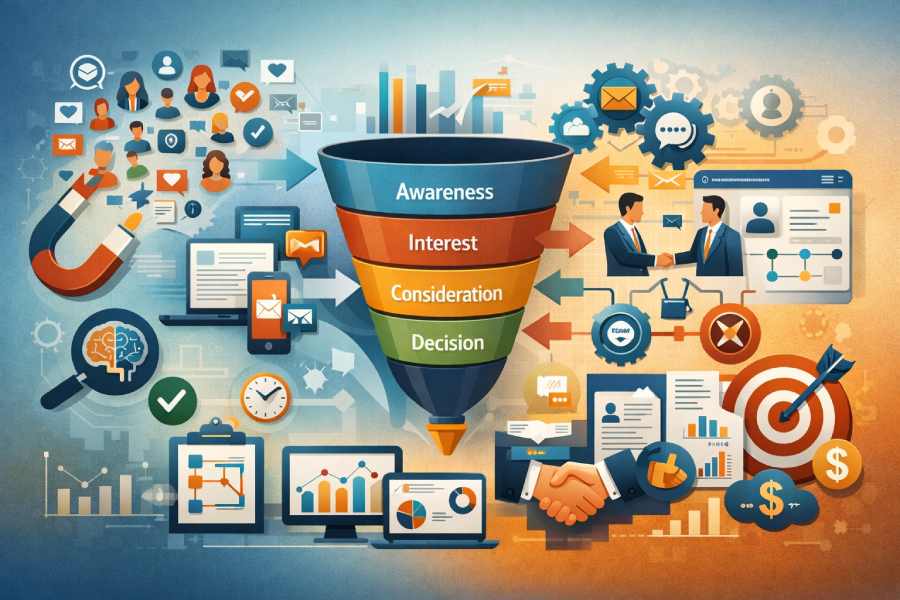
What Is Sales Lead Engagement? A Complete Guide For Modern Sales Teams
Sales lead engagement is a strategic, multi-touch approach that modern sales teams use to build meaningful connections with prospects and guide them through the sales funnel. Rather than relying on one-off outreach, it focuses on delivering the right message at the right time across channels like email, phone, and social platforms, all aligned with the buyer’s journey.
By leveraging tools such as CRM systems, AI-powered insights, and workflow automation, businesses can transform rawleads into qualified opportunities and ultimately drive revenue. In today’s competitive landscape, effective engagement is essential for bridging the gap between lead generation and conversion, ensuring that marketing and sales efforts work together seamlessly to nurture prospects and close deals.
What Sales Lead Engagement Is—and Why It Matters for Modern Sales Teams
Sales lead engagement is the coordinated set of interactions your sales team uses to initiate, develop, and accelerate meaningful conversations with prospects across the sales funnel. Unlike a single touch or a generic blast, sales lead engagement ties every outreach to context, intent, and the buyer journey, so sales reps connect with qualified leads at the right time, on the right channel, with the right message. When engagement is systematic supported by CRM, AI-powered insights, and workflow automation it translates attention into meetings, meetings into opportunities, and opportunities into revenue.
Why it matters now:
- It’s the bridge between lead generation and revenue: without disciplined sales lead engagement, even high-quality lead capture from inbound channels and outbound channels stalls before discovery.
- It boosts conversion rates and pipeline growth by aligning content, cadence, and channel mix to lead temperature (hot leads, warm leads, and cold leads).
- It powers sales and marketing alignment: the marketing team passes marketing qualified leads (MQLs) and product qualified leads (PQLs), while the sales team turns them into sales qualified leads (SQLs) and closed deals through structured lead nurturing and lead scoring.
AI-powered insights and CRM integration make sales lead engagement scalable. With monday CRM from monday.com, revenue teams can centralize engagement data, automate triggered follow-up, and route leads based on demographic fit, behavioral engagement, and buying committee roles—all while giving each sales representative guided, personalized outreach steps.
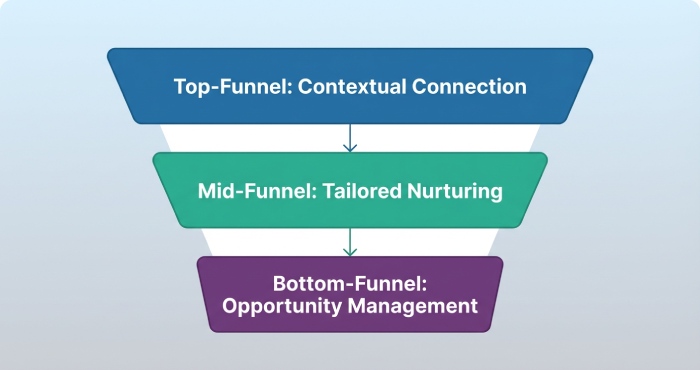
Engagement in the context of the sales funnel and buyer journey
- Top-of-funnel: connect quickly and contextually with prospects from lead magnets, webinars, and content marketing.
- Mid-funnel: progress qualified leads through tailored nurture sequences and conversational marketing that address pains and objections.
- Bottom-funnel: orchestrate opportunity management, implementation frameworks, and comparison guides to win decision-makers’ consensus.
The enablement layer: AI, CRM, and process
- AI-powered insights recommend next best actions and refine lead prioritization based on engagement patterns.
- CRM integration ensures a single system of record for activity, lead scoring, and revenue attribution.
- Automated workflows improve resource management by removing manual steps and standardizing best-practice cadences.
How Engagement Differs from Lead Generation, Qualification, and Nurturing
Sales lead engagement is often conflated with adjacent motions. Here’s how they differ—and connect.
Lead generation vs. engagement
Lead generation is the act of creating interest and capturing contacts via inbound channels (SEO, content marketing, webinars, whitepapers, ROI calculators, industry trend reports) and outbound channels (sales prospecting, social selling on LinkedIn,targeted email outreach, and events). It includes lead capture tactics like automated lead capture forms, landing pages, and lead magnets. Engagement begins after the sales lead generation process produces a record—turning a contact into a conversation through timely, relevant touches.
Qualification vs. engagement
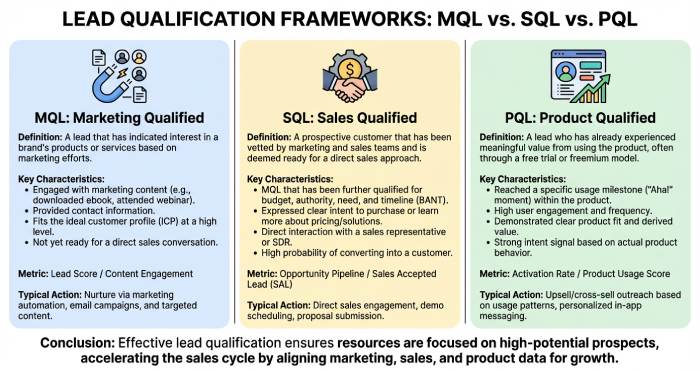
Qualification assigns fit and readiness. Common categories:
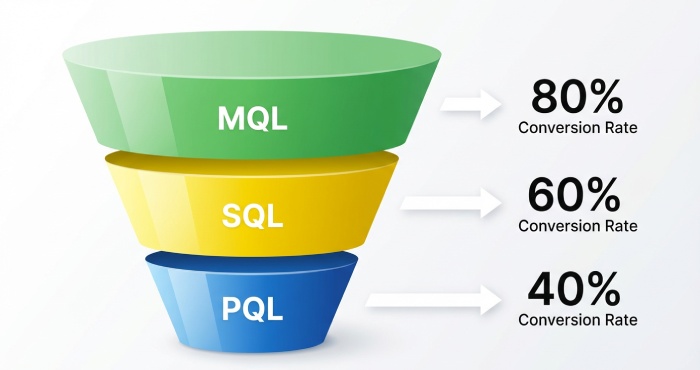
- Marketing Qualified Lead (MQL) / marketing qualified leads (MQLs): Meets campaign and engagement thresholds set by the marketing team.
- Sales Qualified Lead (SQL) / sales qualified leads (SQLs): Validated by a sales rep as an opportunity with need, budget, and timing; often “accepted” by opportunity management.
- Product Qualified Lead (PQL) / product qualified leads (PQLs): Shows in-product intent (trials, feature usage) that signals purchase readiness.
Engagement uses these statuses to tailor outreach. For example, MQLs may need more education; SQLs require stakeholder alignment; product qualified leads may need pricing, comparison guides, or implementation frameworks.
Lead nurturing vs. engagement
Lead nurturing delivers sequenced content and experiences over time. Sales lead engagement encompasses nurturing, plus real-time conversations, meeting setting, and multi-threading with decision-makers. It operationalizes nurture sequences across personalized outreach, conversational marketing (chat), social selling, and email outreach—while dynamically adjusting to lead temperature for hot leads, warm leads, and cold leads.
Sales prospecting vs. engagement
Prospecting is identifying and researching potential accounts and contacts; engagement is the act of interacting to move them forward. Strong engagement compresses time-to-SQL by combining research, outreach, and triggered follow-up within coordinated plays.
The Lead Engagement Lifecycle: Stages, Triggers, and Key Touchpoints
Stages across the customer journey
- Awareness: Connect fast after lead capture. Use content marketing assets (case studies, customer testimonials, whitepapers) that map to buyer personas.
- Consideration: Address objections with comparison guides and industry trend reports; involve technical champions with product qualified leads content.
- Decision: Facilitate consensus among decision-makers with tailored demos, ROI calculators, and implementation frameworks, converting marketing qualified leads (MQLs) and product qualified leads into sales qualified leads (SQLs).
Triggers and timing that improve response
- Behavioral engagement: demo requests, high-intent page views, webinar attendance, and in-product actions for PQLs.
- Demographic fit: ideal customer profile criteria using company demographics (industry, size, tech stack).
- Engagement patterns: repeated visits, content depth, and account-level surges indicating buyer committees mobilizing.
Speed-to-lead best practice
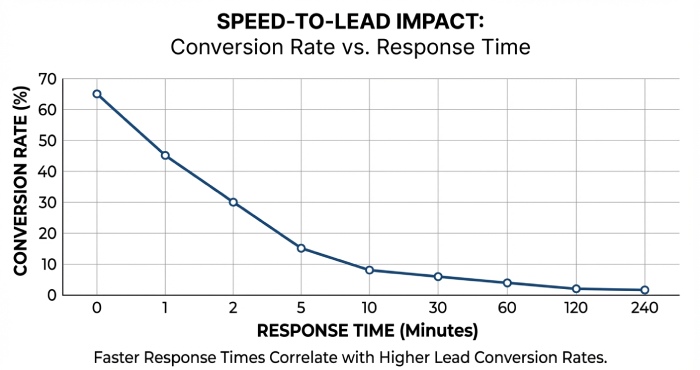
Lead Response Management research shows contacting a new inquiry in minutes dramatically increases conversion rates. AI-powered insights and workflow automation should push instant tasks to sales reps.
Multi-threading the buying group
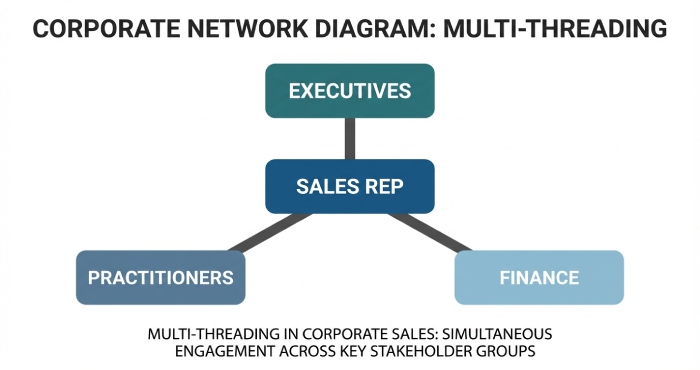
Map the buying committee and reach multiple roles to de-risk deals. Route messaging by persona and function to improve meeting set rate and lead scoring accuracy.
Key touchpoints that compound impact
- Email outreach for rapid confirmation and next steps.
- LinkedIn for social selling, credibility, and community building.
- Phone and chat for conversational marketing and discovery.
- Webinars and workshops to accelerate consensus.
- In-product prompts for product qualified leads to engage at critical “aha” moments.
Handoffs, routing, and process control
Use CRM integration to enforce SLA-driven handoffs from MQLs to SQLs, and from SDRs to AEs. In monday CRM, automated workflows can apply lead prioritization rules, assign owners, and schedule triggered follow-up while maintaining visibility for revenue teams across opportunity management.
Targeting the Right Leads: ICPs, Personas, and Buying Committees
Ideal customer profile foundations
An ideal customer profile defines the accounts your solution best serves. It blends company demographics (vertical, size, region), tech environment, and success indicators. A sharp ideal customer profile increases the proportion of qualified leads entering the sales funnel and ensures lead scoring reflects both demographic fit and potential LTV.
Buyer personas and role-specific messaging
Create buyer personas for economic buyers, technical evaluators, and daily users. Tailor personalized outreach and lead nurturing to each role:
- Executives: value, risk, and implementation frameworks.
- Practitioners: workflows, integrations, and case studies.
- Finance: ROI calculators, customer testimonials, and pricing comparison guides.
Buying committees in B2B contexts
In B2B, most deals involve multiple decision-makers. Sales lead engagement must multi-thread across champions, influencers, and approvers. Tools like monday CRM help sales reps visualize relationships and plan stakeholder-specific nurture sequences. On LinkedIn, sales representatives can identify gaps in coverage and coordinate with the marketing team for account-based content marketing.
Connecting ICPs to qualification paths
Well-defined ICPs streamline the journey from marketing qualified leads (MQLs) to sales qualified leads (SQLs) to won deals. For product-led motions, align product qualified leads with ICP traits to focus PQLs on accounts with the highest propensity to purchase and expand.
Signals and Prioritization: Intent Data, Lead Scoring, and Routing
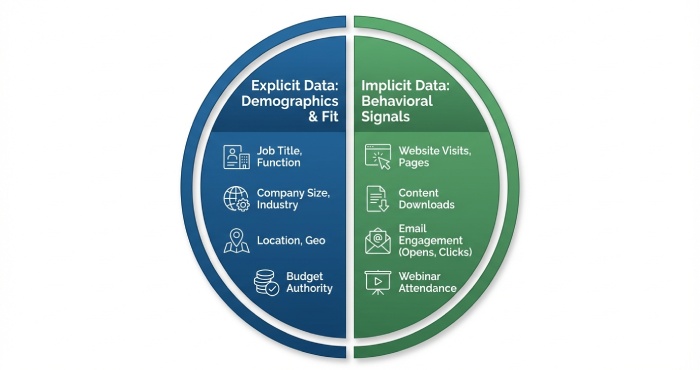
Building a modern lead scoring model
Blend explicit data (demographic fit to the ideal customer profile) with implicit data (behavioral engagement and engagement patterns). Weight signals such as:
- Content depth: whitepapers, case studies, and webinars.
- Buying signals: pricing page views, ROI calculators, and competitive comparison guides.
- Product usage events for product qualified leads and PQLs.
AI-powered insights can refine lead scoring and detect surges at the account level, highlighting hot leads. MQLs with moderate activity may be warm leads requiring more lead nurturing, while cold leads get longer nurture sequences. Across the sales funnel, repeat references to marketing qualified leads (MQLs), sales qualified leads (SQLs), and product qualified leads reinforce clarity in routing and expectations for prospects and sales reps alike.
Routing, SLAs, and automation
Establish routing that balances fairness, specialization, and speed:
- Route by ICP segment and company demographics to the best-fit sales team.
- Use workflow automation in monday CRM to trigger tasks, schedule calls, and orchestrate personalized outreach.
- Apply Lead Response Management principles for triggered follow-up within minutes.
AI, CRM integration, and automated workflows ensure that MQLs and product qualified leads are rapidly triaged, while SQLs are escalated to opportunity management with clear next steps. This supports sales and marketing alignment and improves resource management.
Measuring and optimizing engagement
Track conversion rates at each stage—MQL to SQL, SQL to opportunity, and opportunity to closed/won—to diagnose friction. Monitor lead temperature shifts and adjust messaging. Incorporate feedback loops from sales representatives and enablement leaders. As Sean O’Connor and other practitioners at monday.com emphasize in public talks, operational clarity—definitions, SLAs, and dashboards—drives discipline.
Practical accelerators:
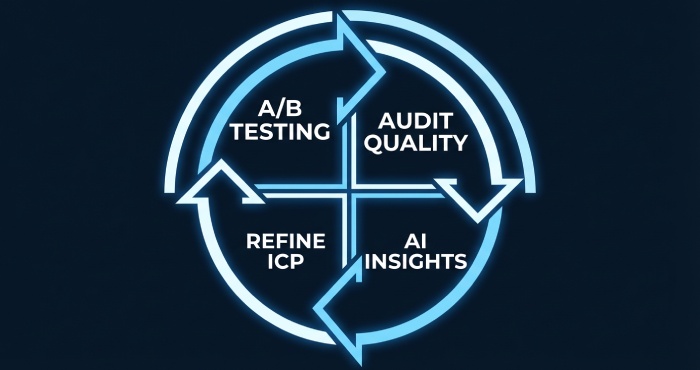
- A/B test sequences across email outreach, conversational marketing, and social selling.
- Use industry trend reports and community building to nurture early-stage prospects.
- Audit the sales lead generation process for lead capture quality and ICP adherence.
- Continuously refine the ideal customer profile and lead scoring thresholds with AI-powered insights.
By institutionalizing these signals and prioritization methods, revenue teams create a repeatable system where marketing qualified leads (MQLs), sales qualified leads (SQLs), and product qualified leads flow smoothly through the customer journey—and your sales team engages every high-intent prospect at precisely the right moment.
Messaging That Converts: Personalization Frameworks and Value Propositions
Build on the ICP, buyer personas, and contextual signals
High-converting messaging starts with a precise ideal customer profile and detailed buyer personas that capture demographic fit, company demographics, and behavioral engagement. Map pains and priorities for each persona across the buyer journey so your sales team can speak to what prospects care about at each stage of the sales funnel. Use AI-powered insights from engagement patterns, content consumption, and product usage to tailor messaging that converts more qualified leads from both inbound channels and outbound channels.
Value propositions tied to pains, gains, and jobs-to-be-done
Anchor your value propositions in a simple narrative: problem, impact, and outcome. For marketing qualified leads and MQLs, highlight business outcomes and comparison guides; for sales qualified leads and SQLs, quantify time-to-value with ROI calculators and case studies; for product qualified leads and PQLs, emphasize features tied to observed usage. This level of lead nurturing elevates sales lead engagement, improves conversion rates, and moves prospects decisively through the sales lead generation process.
A concise message formula that scales
- Relevance: “For [role] at [industry/company size],”
- Problem: “who struggle with [pain], causing [cost/lag],”
- Proof: “our customers (see [case study/whitepapers]) achieved [metric],”
- Outcome: “so you can [priority outcome] without [risk/constraint].”
Personalization tiers and tokens that matter
Match personalization depth to lead temperature. For cold leads, use firmographic tokens and an industry trend report; for warm leads, reference recent webinars or whitepapers they viewed; for hot leads, cite specific product actions from PQLs alongside triggered follow-up. AI-powered insights and lead scoring help your sales reps decide when to escalate to a sales representative for live discovery, reinforcing sales lead engagement while preserving resource management.
Examples by lead temperature
- Cold leads: relevance + insight + soft CTA to a comparison guide.
- Warm leads: behavior-based hook + customer testimonials + next-step CTA.
- Hot leads: business case preview + ROI calculator + direct meeting CTA.
Social proof and content assets embedded in outreach
Weave content marketing into your personalized outreach: sequence customer testimonials early for authority, link case studies by vertical for credibility, and offer implementation frameworks for SQLs nearing decision. For MQLs and marketing qualified leads, combine lead magnets with conversational marketing on chat to accelerate lead capture. For PQLs and product qualified leads, embed short videos that translate in-app value to executive outcomes for decision-makers.
Multichannel Outreach and Cadence Design (email, phone, social, SMS, video, chat)
Channel strategy by segment and lead temperature
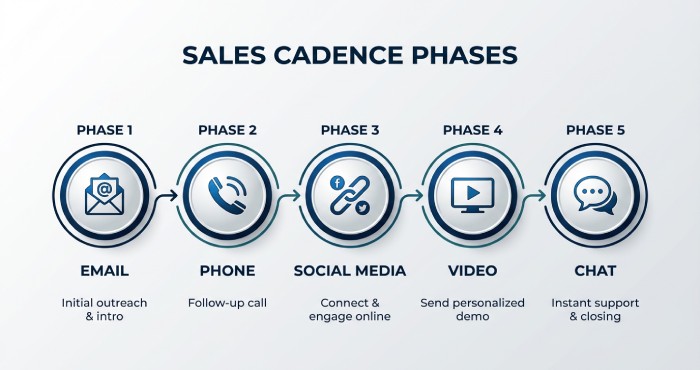
Design cadences that flex by segment and lead temperature: hot leads deserve immediate phone plus SMS, warm leads get email outreach plus LinkedIn social selling, and cold leads respond best to value-led email plus light-touch chat. The goal is sustained sales lead engagement that respects buyer preferences while advancing qualified leads through the sales funnel.
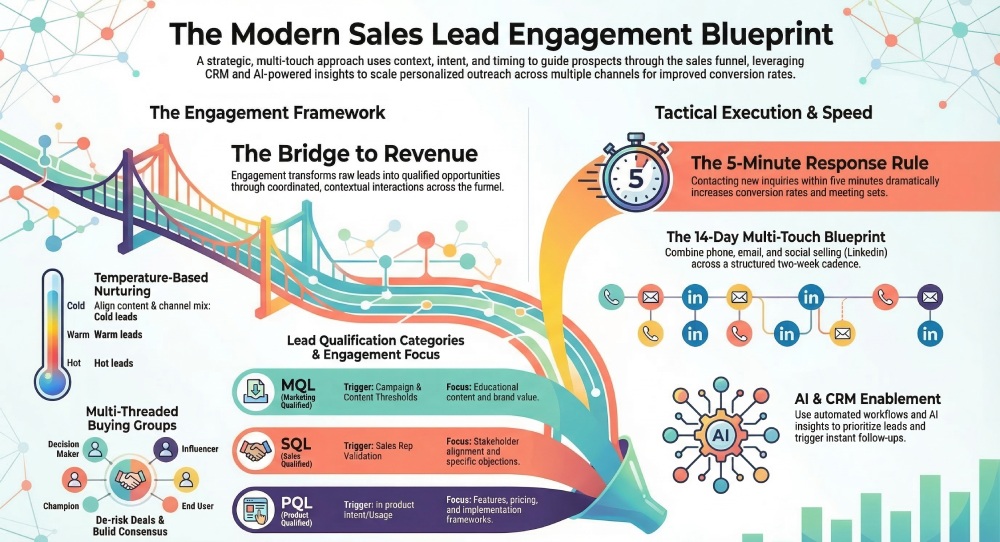
A 14-day, multi-touch blueprint with triggered follow-up
- Day 0–1: Email + call within minutes of lead capture; if no connect, SMS reminder.
- Day 2–4: Social touch on LinkedIn, value email with case study, second call.
- Day 5–7: Video message, chat nudge if active on site; triggered follow-up on link clicks.
- Day 8–10: Call block + email offering ROI calculators or comparison guides.
- Day 11–14: Executive-angle email, industry trend report, final call. Automated workflows adjust based on engagement patterns to prioritize SQLs and fast-track PQLs showing in-product intent.
Social selling and conversational marketing done right
Leverage social selling to warm up prospects with relevant commentary, micro-education, and community building. Use conversational marketing on chat to answer questions in the moment, route hot leads to the appropriate sales representative, and start nurture sequences for those earlier in the customer journey. This multichannel precision amplifies lead generation and pipeline growth without sacrificing compliance.
Timing and Speed-to-Lead: Cadences, SLAs, and SDR–AE–Marketing Alignment
Lead Response Management and speed benchmarks
Lead Response Management research consistently shows dramatic gains when response times shrink from hours to minutes. Establish SLAs that target sub-5-minute first-touch on inbound channels to boost MQL-to-SQL conversion rates. Practitioners such as Sean O’Connor emphasize that speed-to-lead, supported by AI-powered insights, is foundational to sales lead engagement and the progression of qualified leads.
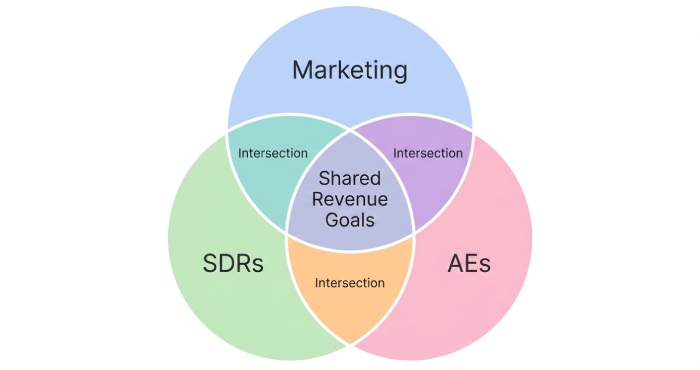
SDR–AE handoffs and sales and marketing alignment
Codify when an inquiry is a Marketing Qualified Lead versus a Sales Qualified Lead to reduce friction between the marketing team and quota-carrying sales reps. Define clear criteria for SQLs and Product Qualified Lead triggers, then orchestrate warm introductions from SDR to AE with notes on demographic fit, behavioral engagement, and opportunity management next steps using Nureply. This sales and marketing alignment preserves momentum in the sales funnel and prevents leakage.
Routing, lead prioritization, and SLAs across channels
Use lead scoring to elevate high-intent prospects to the top of the queue, incorporating company demographics, content touches, and product signals. Create SLAs for each channel (phone, email outreach, chat) and ensure workflow automation escalates hot leads to live connect attempts. For warm leads, schedule nurture sequences; for cold leads, park into longer-term lead nurturing with periodic webinars and whitepapers.
Tools and Tech Stack: CRM, Sequencers, Data Enrichment, AI, and Analytics
The CRM as system of record with seamless CRM integration
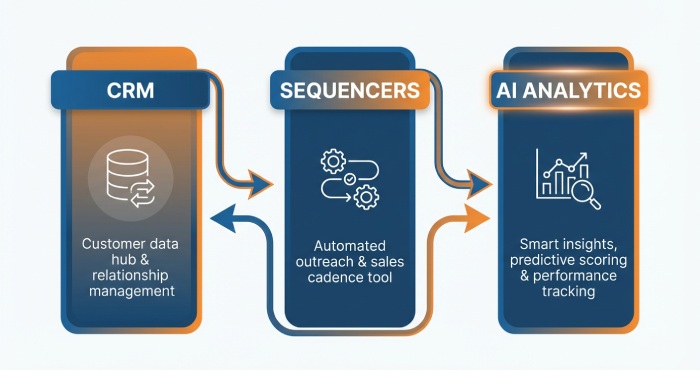
A robust CRM is the anchor for revenue teams. Platforms like monday CRM from monday.com centralize automated lead capture, deal stages, lead scoring fields, and AI-powered insights for prioritization. Deep CRM integration with marketing automation ensures MQLs, SQLs, and PQLs are tracked consistently so the sales team can act fast and improve sales prospecting.
Sequencers, enrichment, and workflow automation
Sales engagement tools coordinate multichannel cadences, triggered follow-up, and personalized outreach at scale. Data enrichment fills gaps in company demographics and decision-makers, while workflow automation assigns owners, kicks off nurture sequences, and updates lead temperature based on real-time activity. This stack supports lead generation at volume while ensuring qualified leads receive the right touch at the right time.
Analytics, attribution, and AI-powered insights
Dashboards unify conversion rates by stage (Marketing Qualified Lead to Sales Qualified Lead to closed-won), pipeline growth by source, and content performance. AI models surface propensity scores, suggest next-best-actions, and refine messaging by persona to heighten sales lead engagement. Over time, analytics inform the sales lead generation process, optimizing inbound channels and outbound channels across the full sales funnel.
Measurement, Compliance, and Continuous Improvement: KPIs, Privacy, and Playbooks
KPIs that matter across the funnel
Track the flow from marketing qualified leads (MQLs) to sales qualified leads (SQLs) to product qualified leads (PQLs), alongside time-to-first-touch, meeting rate, and stage conversion rates. Monitor lead temperature shifts hot leads, warm leads, and cold leads to assess lead prioritization efficacy and the impact of lead nurturing. Tie these to opportunity management outcomes and revenue to quantify the effectiveness of your sales team.
Privacy-first outreach and regulatory discipline
Respect consent and regional regulations for phone, SMS, and email outreach, and document preferences within the CRM. Adopt double opt-in for lead magnets, clearly disclose data use, and throttle cadence volume to minimize risk. This discipline sustains brand trust while preserving the ability to engage prospects with compliant, high-quality messaging.
Playbooks, experimentation, and coaching loops
Establish repeatable playbooks with hypothesis-based testing A/B subject lines, CTA placement, and channel ordering to improve sales lead engagement. Use implementation frameworks to standardize onboarding for new sales reps, then iterate monthly with insights from industry trend reports and field feedback. Continuous improvement turns more prospects into qualified leads and accelerates lead generation without overwhelming resource management.
FAQs
How personalized should my outreach be for different lead temperatures?
Use lightweight firmographic personalization for cold leads, behavior-based references for warm leads, and specific product or business triggers for hot leads. Calibrate effort with lead scoring and AI-powered insights so your sales team spends time where impact is highest.
What KPIs best indicate progress through the sales funnel?
Track marketing qualified leads (MQLs), sales qualified leads (SQLs), and product qualified leads (PQLs) alongside meeting rate, cycle time, and stage-by-stage conversion rates. Layer channel attribution to see which inbound channels and outbound channels drive pipeline growth.
How fast should we respond to new inquiries?
Aim for a sub-5-minute response for inbound MQLs to maximize connect rates, as supported by Lead Response Management benchmarks. Use workflow automation to alert a sales representative instantly and trigger the first touches across email, phone, or chat.
Which channels work best for B2B outreach?
A balanced mix of email outreach, phone, LinkedIn social selling, and occasional SMS typically performs well in B2B. Add video and conversational marketing on site or in-app to boost sales lead engagement for PQLs and high-intent prospects.
How do I align SDRs, AEs, and the marketing team?
Define MQL, SQL, and PQL criteria, set SLAs for each stage, and document handoffs with clear acceptance rules. Review funnel metrics together weekly so revenue teams share accountability for qualified leads and opportunity management.
Key Takeaways
- Anchor messaging in your ideal customer profile and persona pains, then scale personalization with AI-powered insights and content proof.
- Design multichannel cadences that flex by lead temperature and use triggered follow-up to sustain sales lead engagement.
- Enforce speed-to-lead service level agreement (SLA) and clear MQL, SQL, and PQL criteria to protect momentum through the sales funnel.
- Build a tech stack around CRM integration, sequencers, enrichment, and analytics to power lead scoring and workflow automation.
- Measure conversion rates and pipeline growth rigorously, stay privacy-compliant, and iterate playbooks for continuous improvement.