Email Marketing Vs Cold Calling: Pros, Cons, And Hybrid Strategies That Win
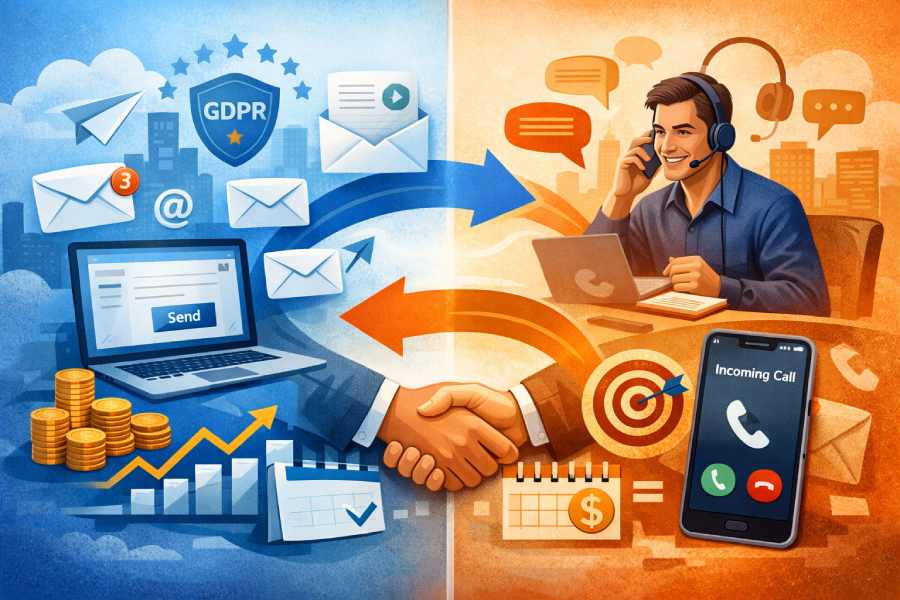
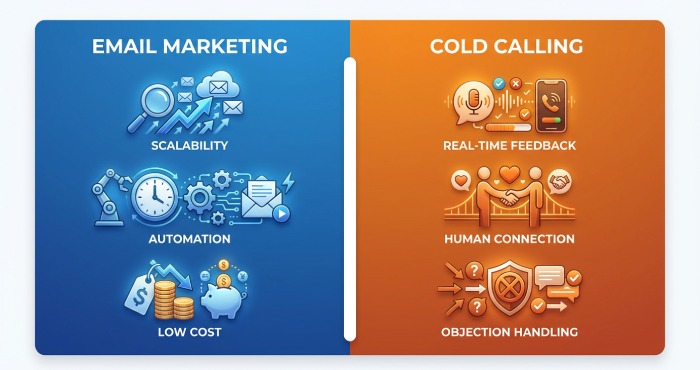
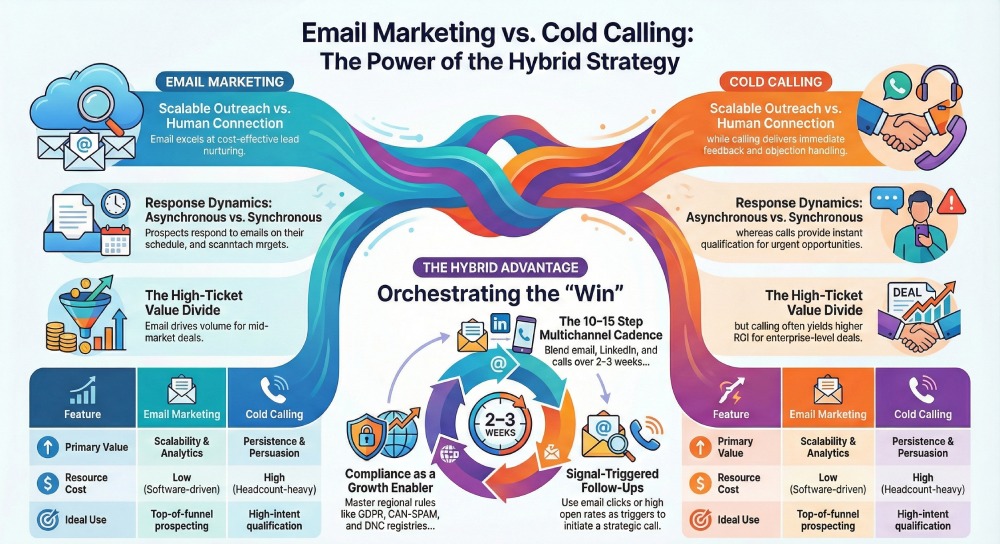
In today’s competitive sales landscape, email marketing and cold calling remain two powerful outbound strategies, each with distinct strengths and limitations. Email marketing offers scalability, automation, personalization at scale, and measurable analytics making it cost-effective and ideal for nurturing leads over time while cold calling delivers real-time human connection, immediate feedback, and the ability to handle objections on the spot, which can significantly boost conversion rates when executed well.
However, emails can be ignored or lost in crowded inboxes, and cold calling can feel intrusive and resource-intensive. The real advantage lies in a smart hybrid strategy: using email to warm prospects with valuable insights and targeted messaging, then following up with strategic calls to deepen engagement and accelerate decision-making. By combining the efficiency of digital outreach with the persuasive power of live conversation, businesses can create a multi-touch approach that increases response rates, builds trust faster, and ultimately drives stronger revenue outcomes.
Why the Email vs Cold Calling debate still matters (and what has changed)
The debate between email marketing and cold calling persists because buyer preferences, regulations, and tech stacks keep evolving, but the fundamentals of B2B sales remain: you must reach the right prospects, at the right time, with a compelling value proposition. In today’s outbound sales environment, teams blend cold email and calls into a coordinated multichannel sequence to improve open rate, reply rate, and ultimately conversion rate across the sales pipeline.
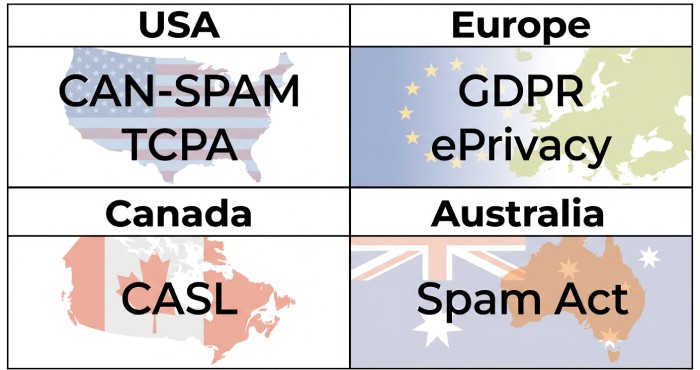
What has changed is the context stringent compliance regimes (CAN-SPAM Act in the U.S., GDPR and the ePrivacy Directive in the EU, CASL/Canada’s Anti-Spam Legislation, PECR in the U.K., and Australia’s Spam Act 2003), call restrictions (TCPA, the Telemarketing Sales Rule, and the National DNC Registry/Do Not Call Registry), and signal-dense channels like LinkedIn.
Email marketing and cold email have matured with deliverability controls, hyper-personalization, and automation tools such as Saleshandy that orchestrate campaigns, measure open rates and reply rate, and support appointment setting. Meanwhile, cold calling has adapted with local presence dialing, voicemail strategies, and improved talk tracks that create a faster 1:1 conversation.
For high-ticket sales and enterprise deals, both sales techniques still win but only when integrated into a thoughtful sales cadence that respects timing, volume, and compliance. The success rate now depends less on picking one channel and more on executing a coordinated outreach and prospecting motion that fits your ICP and aligns to stage-by-stage buyer intent in B2B sales.
How each channel works: Workflows, response dynamics, and resource requirements
Email marketing and cold email workflows
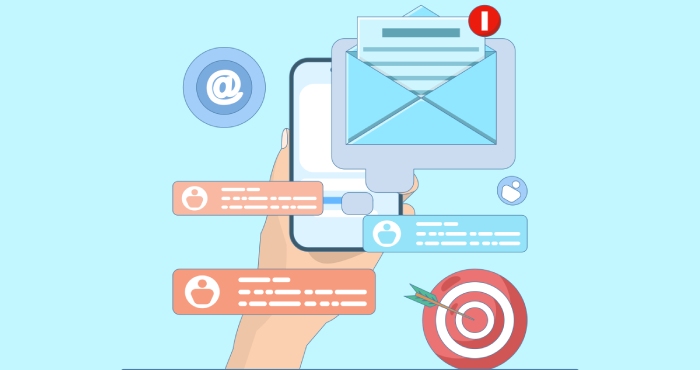
Email marketing in outbound sales relies on lists, segmentation, and messaging frameworks that guide subject line, personalization, and call to action. Cold email uses smaller, targeted sends, layered into a multichannel sequence with LinkedIn touches and occasional calls. A typical workflow includes data sourcing for prospecting, drafting templates with a clear value proposition, setting send windows for optimal timing, and A/B testing to improve open rate, reply rate, and conversion rate. Tools like Saleshandy help with sequence building, warm-up, and analytics, giving sales representatives visibility into meetings booked and enabling fast follow-up for appointment booking.
Compliance is table stakes: CAN-SPAM Act in the U.S., GDPR and PECR in the EU/U.K., CASL/Canada’s Anti-Spam Legislation (National DNCL for calls), and Australia’s Spam Act 2003 require clear identification, lawful basis (where relevant), and easy opt-out. Global teams need policies that separate U.S., EU, and Australia rules, and an internal playbook for consent, storage, and unsubscribe management. When done well, email marketing drives efficient lead generation and pipeline building at scale, producing warm email leads for later-stage business conversation and sales meeting handoffs.
Cold calling workflows
Cold calling centers on rapid connects, a professional tone, and a crisp first touch that earns a short business conversation. Workflows include list prioritization, local presence numbers to lift connection rates, call blocks aligned to buyer time zones, and structured talk tracks that end with a firm call to action for appointment setting or meetings booked. Voicemail remains a useful touchpoint when crafted as a brief teaser that supports the multichannel sequence and prompts a reply via email or LinkedIn. Effective cold calling requires trained sales representatives, QA on recordings, and coaching on objection handling this sales technique shines in complex B2B sales where a 1:1 conversation accelerates qualification.
Compliance is non-negotiable: the TCPA, Telemarketing Sales Rule, and the National DNC Registry govern the U.S.; Canada uses the National DNCL; Australia enforces the Do Not Call Register. Teams must scrub lists, manage consent, and document processes to protect ROI and success rate. Resource requirements are higher than cold email, more headcount, manager oversight, and tooling for dialers and call analytics but the immediacy of feedback can lift conversion rate for urgent opportunities and enterprise deals.
Response dynamics and timing
Cold email is asynchronous: prospects respond on their schedule, which makes volume and timing crucial. Sequenced follow-up over 10–15 business days can boost open rates and reply rate, while strong subject line testing and hyper-personalization compound results. Cold calling is synchronous, delivering instant qualification and faster appointment setting when the prospect picks up.
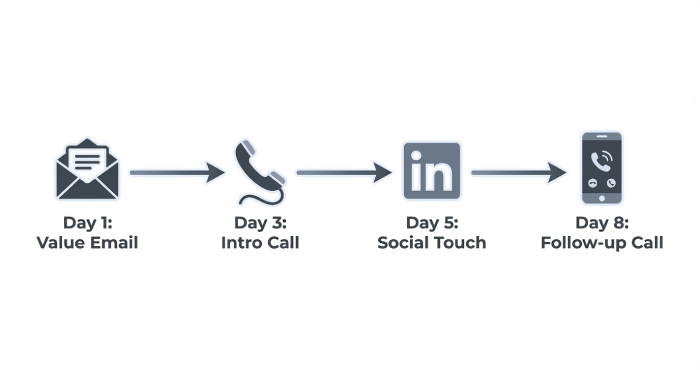
The best outbound campaign blends both: an initial cold email as a low-friction first touch, a call as the second or third touchpoint, then alternating channels within a disciplined sales cadence. This multichannel sequence tends to lift overall conversion rate because it meets buyers where they are, some prefer email marketing, others prefer a quick call.
Pros and cons side-by-side: Cost, speed, scale, conversion quality, and relationship depth
Cost and cost-effectiveness
Cold email often delivers a lower cost per booked meeting than pure cold calling because software scales cheaper than phone time. For small teams or bootstrapped budgets, email marketing is a cost-effective backbone for lead generation and pipeline building. Cold calling demands more SDRs, but its ROI can outshine email when deal sizes are large and meetings booked are highly qualified. Benchmarks vary by industry and ICP, but blended models typically reduce cost per booked meeting while maintaining quality.
Speed, scale, and volume
Email marketing and cold email scale to thousands of contacts per week, letting outbound sales teams hit volume targets while measuring open rate, reply rate, and downstream conversion rate. Cold calling scales more slowly each 1:1 conversation takes time but when timing is right, it compresses cycles and accelerates appointment booking. A coordinated multichannel sequence maximizes reach: email for scale, calls for speed, plus LinkedIn and voicemail for additional touchpoints without overwhelming the prospect.
Conversion quality and meetings booked
For high-ticket sales and complex B2B sales motions, cold calling can increase conversion quality because it surfaces pain, budget, and authority in minutes. Email marketing and cold email nurture interest with educational content, case studies, and a clear value proposition that warms up the sales meeting. Many teams see the highest success rate by triggering a call after a positive signal multiple opens, a click, or a constructive reply turning warm email leads into high-intent meetings booked and raising end-to-end conversion rate.
Relationship depth and buyer preferences
Relationship sales benefit from the human dynamics of cold calling: tone, empathy, and real-time discovery. Yet buyer preferences differ; some executives in B2B SaaS want a crisp email with next steps, while others in agency or channel deals prefer a quick call. Local presence dialing can lift connections, while a professional tone in both channels builds trust. The right sales technique adapts: start with cold email to introduce value, then escalate to a call for a richer business conversation when interest is detected.
Audience fit and buyer’s journey: ICP, deal size, urgency, and stage-by-stage best uses
Ideal customer profile and deal size
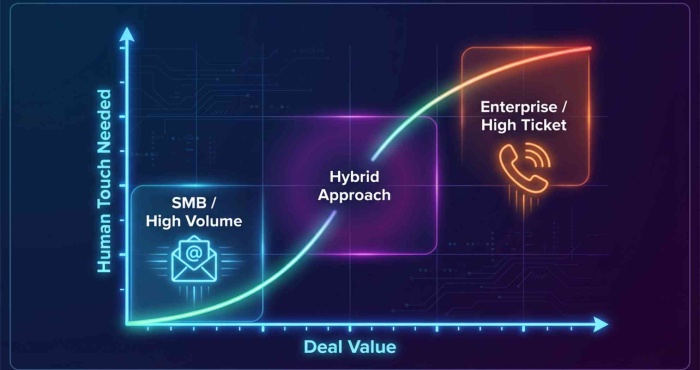
ICP dictates channel mix. For enterprise deals and high-ticket sales, prioritize cold calling for senior personas, supported by targeted cold email and LinkedIn messages. Mid-market sales teams often combine both channels evenly, while small teams lean on email marketing for efficient lead generation. Global teams should localize messaging, respect regional compliance (GDPR in the EU, CASL in Canada, Spam Act 2003 in Australia), and schedule outreach to local business hours. In B2B SaaS, technical buyers may prefer documentation links in email; in agency or channel deals, a consultative call can unlock context faster.
Urgency and timing triggers
When urgency is high—expiring budgets, regulatory deadlines, or competitive displacement—cold calling as the first touch can accelerate qualification and appointment setting. For longer horizons, cold email nurtures interest with educational assets and time-bound calls to action, especially when supported by automation tools like Nureply to personalize outreach at scale.
Use intent signals to adjust timing: a high open rate across a thread, a reply requesting details, or a link click should trigger immediate follow-up by a sales representative. Conversely, when timing is uncertain, maintain a light-touch sales cadence with periodic email marketing and occasional voicemail to stay top-of-mind without causing prospect fatigue.
Stage-by-stage best uses across the sales pipeline
- Top of funnel: leverage cold email for scalable prospecting and outreach, testing subject line variants and hyper-personalization to raise open rates and reply rate. Add a cold calling step on high-fit accounts to fast-track qualification.
- Middle of funnel: convert warm email leads into live business conversation via scheduled calls. Here, appointment setting benefits from coordinated touchpoints, email reminders, LinkedIn nudges, and a final confirmation call to protect meetings booked and improve success rate.
- Bottom of funnel: for late-stage enterprise deals, prioritize 1:1 conversation to resolve risk, align stakeholders, and secure signatures. Maintain supportive email marketing for stakeholders who need collateral. Across all stages, treat the multichannel sequence as a living system: monitor conversion rate, refine value proposition, and iterate the outbound campaign to improve ROI while honoring compliance under the TCPA, CAN-SPAM Act, GDPR, CASL, PECR, the ePrivacy Directive, the National DNCL, the Do Not Call Register, and the National DNC Registry/Do Not Call Registry in the U.S.
Compliance, deliverability, and risk: CAN-SPAM/GDPR, TCPA, list quality, and call permissions
Regional regulations every outbound team must master
- U.S. compliance landscape
- The CAN-SPAM Act governs commercial cold email content, opt-out mechanisms, and sender identification in the U.S., while the Telephone Consumer Protection Act (TCPA), the National DNC Registry, and the Telemarketing Sales Rule restrict cold calling, autodialers, and texting without consent. Cross-check numbers against the Do Not Call Registry and maintain internal DNC lists for all outbound sales activity. These rules apply whether you’re doing lead generation for B2B sales or high-volume outreach across mid-market sales teams.
- EU and UK standards
- The GDPR and the ePrivacy Directive (and UK PECR) require a lawful basis for email marketing and cold email to corporate addresses, along with clear transparency and data minimization. For cold calling in the EU, obtain call permissions aligned with local interpretations of ePrivacy; document legitimate interests and make opt-out easy in every touchpoint of your multichannel sequence.
- Canada and Australia
- Canada’s Anti-Spam Legislation (CASL) and the National DNCL demand express or implied consent for commercial messages, impacting email marketing cadences and appointment setting workflows. In Australia, the Spam Act 2003, combined with the Do Not Call Register, sets strict rules for cold calling and commercial messages; ensure your agency or B2B SaaS team enforces opt-outs across channels.
Data quality, consent, and list hygiene
- Permission-first prospecting
- Collect and process data in line with GDPR principles; verify corporate emails via a double-validated source and confirm role relevance to buyer preferences. Good list quality lifts open rate, reply rate, and conversion rate across cold email, LinkedIn outreach, and cold calling.
- Deliverability controls
- Authenticate domains (SPF, DKIM, DMARC), warm up new sending domains, and segment volume to maintain strong open rates. Remove hard bounces, track spam signals, and throttle sends by time zone for optimal timing. Clean data and compliant opt-outs improve success rate and the cost-effectiveness of outbound sales.
- Call permissions and audit trails
- Record consent basis, internal DNC flags, and call outcomes in your CRM. For the U.S., log checks against the National DNC Registry; for Canada, the National DNCL; and for the UK/EU/Australia, relevant national lists. This discipline protects your sales representative and brand while sustaining pipeline building.
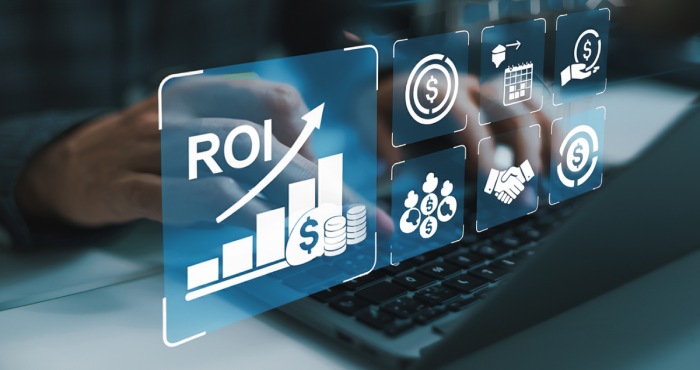
Metrics that matter and ROI modeling: From open and connect rates to CAC, LTV, and payback
Funnel diagnostics for cold email and cold calling
- Top-of-funnel
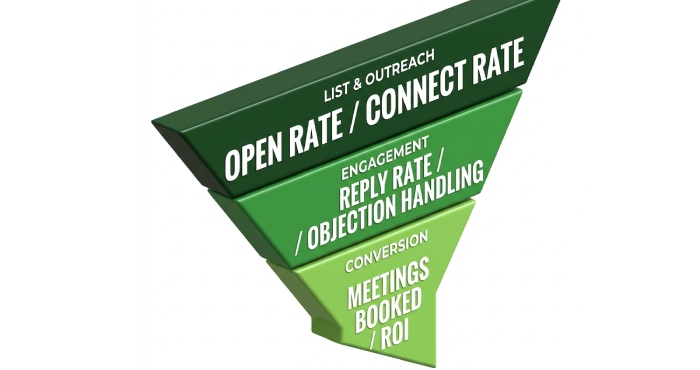
- Track open rate, open rates by segment, connect rate on phone, and initial reply rate by subject line and persona. Benchmark these against historical campaigns and industry benchmarks to spot message-market fit issues in prospecting and outreach.
- Mid-funnel
- Monitor positive reply rate, meetings booked, and appointment setting efficiency per sales technique and per multichannel sequence. Tie each touchpoint to a clearly defined call to action to preserve momentum toward a sales meeting or business conversation.
- Bottom-of-funnel
- Attribute opportunities created, stage-by-stage conversion rate, and velocity through the sales pipeline. Compare performance across cold email-only vs. hybrid cadences to quantify which outbound campaign produces higher ROI.
Financial modeling that boards trust
- CAC, LTV, and payback
- Calculate fully loaded CAC for email marketing, cold calling, and LinkedIn prospecting, including tools, data, and labor. Roll up average LTV and expected payback by deal segment (mid-market, enterprise deals, and high-ticket sales) to prioritize the most profitable channels and sales technique combinations.
- Cost per booked meeting
- Track cost per booked meeting and cost per opportunity by channel and multichannel sequence. This clarifies volume and cost-effectiveness tradeoffs, guiding where small teams with bootstrapped budgets should invest versus global teams optimizing scale.
- Dashboard essentials
- Build a scorecard spanning open rate, reply rate, connect rate, meetings booked, conversion rate to opportunity, and win rate. Layer in benchmarks and cohort trends to reveal which sequences, cadences, and first touch strategies sustain the sales pipeline.
Message strategy and creative: Personalization at scale, subject lines, openers, and voicemail
Personalization tiers that scale
- Smart segmentation
- Start with firmographic and intent data to group accounts; then deploy personalization and selective hyper-personalization where impact justifies time. Use warm email leads and event triggers to lift reply rate and conversion rate without sacrificing volume.
- 1:1 conversation at scale
- Even in email marketing, write like a 1:1 conversation: concise, relevant, and with a professional tone. Align the value proposition to a quantified problem and make the call to action frictionless, whether it’s a quick sales meeting or appointment booking.
Subject lines and openers that earn attention
- Subject line principles
- Keep the subject line under 50 characters, avoid spammy terms, and test curiosity vs. clarity. Tie preview text to a distinct benefit to boost open rate and stabilize open rates over time.
- Openers that create lift
- Lead with context (trigger, role, or metric) and move quickly to the value proposition. For cold email and outreach on LinkedIn, the first sentence should pay off the subject line and set up a specific call to action.
Voicemail and call scripts that convert
- Voicemail technique
- In cold calling, leave a short voicemail that references a relevant trigger and your multichannel sequence. Offer a single, low-friction next step: your name, number, and a crisp reason to call back to increase connection rate and downstream conversion rate.
- Talk track
- Use a professional tone, show local presence when helpful, and steer toward a brief business conversation rather than a hard pitch. Map questions to buyer preferences by segment (B2B SaaS vs. services) to enable smooth follow-up.
Creative that respects compliance and deliverability
- Clear identity and opt-out
- Every cold email must include accurate sender details and an easy opt-out to align with the CAN-SPAM Act, GDPR transparency, CASL, and PECR. This improves compliance posture and protects domain health that ultimately supports lead generation.
Hybrid strategies that win: Multichannel cadences, triggers, and channel orchestration
Building a multichannel sequence that compounds
- Cadence design
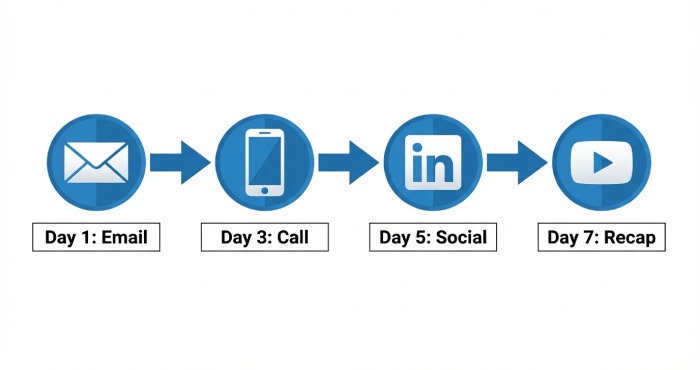
- Combine cold email, cold calling, and LinkedIn messages into a 10–15 step sales cadence over 2–3 weeks. Sequence first touch via email for open rate data, follow-up with a call and a voicemail, and incorporate a LinkedIn touchpoint before a final email recap to lift reply rate.
- Trigger-based outreach
- Use triggers such as funding, hiring, technology changes, and website activity to time outreach. Triggered steps in your multichannel sequence raise success rate, meetings booked, and overall outbound sales efficiency.
Channel orchestration for deal size and segment
- Deal-type alignment
- For enterprise deals and high-ticket sales, prioritize relationship sales with longer, high-signal sequences and more 1:1 conversation. For mid-market, use balanced cadences with measurable touchpoints; small teams can lean on email marketing plus selective calling for cost-effectiveness.
- Regional nuances
- In the U.S., phone remains potent with the right call permissions; in the EU, emphasize compliant cold email and LinkedIn; in Australia, factor the Spam Act 2003 into channel mix. Adapt the multichannel sequence by region to stay within local compliance while sustaining pipeline building.
Tooling and team: CRMs, sequencers, dialers, data providers, and skill development
The modern outbound stack
- Systems and data
- Anchor everything in a CRM for activity capture and sales pipeline reporting. Layer a sequencer like Saleshandy for cold email and email marketing automation, a power dialer for cold calling, data providers for enrichment, and LinkedIn for prospecting signals.
- Compliance and governance
- Enforce suppression lists tied to the National DNC Registry, National DNCL, Do Not Call Register, and internal unsubscribes. Configure templates to include CAN-SPAM Act and GDPR-safe elements; document lawful basis under the ePrivacy Directive and PECR.
Sequencers, dialers, and analytics
- Execution and insights
- Choose sequencers that support multichannel sequence design, A/B testing of subject lines, and granular reply rate reporting. Dialers should show local presence responsibly and record consent; analytics should connect touchpoint data to meetings booked and appointment setting outcomes.
Skills, enablement, and coaching
- Sales technique development
- Train on consultative questioning, objection handling, and concise storytelling for both cold calling and cold email. Role-play first touch, follow-up, and voicemail; coach toward a clear value proposition and a single call to action.
- Operating models
- Mid-market sales teams and global teams need playbooks for handoffs between SDRs and AEs, while small teams with bootstrapped budgets focus on fewer, sharper sequences. Standardize outreach templates but empower personalization to protect reply rate and conversion rate across outbound campaigns and channel deals.
FAQs
What’s the safest way to run cold email in the U.S., EU, Canada, and Australia?
Include accurate sender details, a clear opt-out, and only contact relevant business addresses. Respect the CAN-SPAM Act, GDPR/ePrivacy/PECR, Canada’s Anti-Spam Legislation (CASL), and Australia’s Spam Act 2003, and maintain suppression lists synced to national DNC registries.
How many touchpoints should a multichannel sequence include?
Most B2B sales teams see strong success with 8–15 steps over 2–3 weeks. Blend cold email, cold calling, LinkedIn, and voicemail, and adjust by buyer preferences and deal size.
Which metrics best predict pipeline and revenue?
Track open rate, reply rate, connect rate, meetings booked, and conversion rate to opportunity. Pair these with CAC, LTV, and payback to validate return on investment(ROI) at the program level.
How can we improve deliverability for email marketing and cold email?
Authenticate domains, warm up senders, prune hard bounces, and segment sends by persona and timing. Keep subject lines clean, avoid spam triggers, and provide compliant opt-outs.
When should I leave a voicemail versus sending another email?
After a first touch email, a brief voicemail can raise awareness and connect rate. Use voicemail to reference value succinctly and set up a simple next step, then follow-up with a contextual email.
What tools are essential for outbound sales teams?
A reliable CRM, a sequencer like Saleshandy, a compliant dialer, accurate data providers, and LinkedIn for research are core. Ensure analytics tie every touchpoint to meetings booked and opportunities.
Key Takeaways
- Treat compliance as a growth enabler: align with CAN-SPAM Act, GDPR, CASL, PECR, and DNC rules to protect deliverability and scale.
- Build multichannel sequences that blend cold email, cold calling, and LinkedIn, using triggers and clear CTAs to lift reply and conversion rates.
- Track open rate, reply rate, connect rate, CAC, LTV, and cost per booked meeting to model ROI and prioritize channels.
- Invest in tooling (CRM, sequencer, dialer, data) and coaching to sharpen sales technique, appointment setting, and pipeline building.
- Personalize smartly use segmentation and selective hyper-personalization to balance volume, cost-effectiveness, and outcomes.