
B2b Subject Lines For Cold Emails: Strategies, Examples, And Mistakes To Avoid
B2B subject lines for cold emails can make or break your outreach before the message is even opened. In crowded inboxes, the subject line is your first—and sometimes only—chance to earn attention, spark curiosity, and signal relevance to busy decision-makers. A strong subject line balances clarity with intrigue, speaks directly to a real business pain point, and sets honest expectations for what’s inside the email. This introduction explores proven strategies for writing high-performing B2B cold email subject lines, real-world examples that boost open rates, and common mistakes that quietly kill engagement and lead to instant deletes.
Why subject lines matter in B2B cold outreach: open rate levers, trust, buyer psychology
A cold email is judged first by its subject line. In B2B, that first impression influences open rate, inbox placement, and whether you ever get a shot at sales calls. A compelling subject line doesn’t just earn a click; it signals a reputable sender, boosts deliverability, and nudges the receiver toward a micro-commitment.
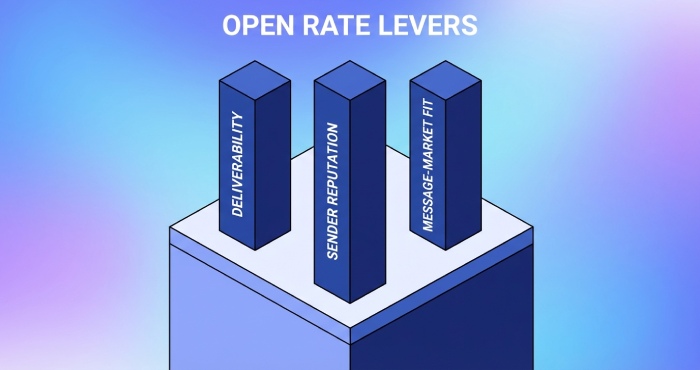
Open rate levers you control
- Deliverability and the primary inbox: You can’t win if you’re not landing in inbox. Deliverability depends on domain reputation, engagement history, and consistent sending. Strong engagement from performing subject lines helps future inbox placement and primary inbox presence, further influencing open rate.
- Sender reputation: Trust compounds. A reputable sender with consistent value, low spam complaints, and clear branding trains prospects to open an email again. Over time, this sender reputation does more for open rate than any one line.
- Message-market fit: Cold email subject lines that match the receiver’s context—industry, role, and trigger events—raise curiosity without being SPAMMY.
Trust and the “is this safe?” test
B2B buyers run instant trust checks: Does this look like a coworker or friend? Is the sales person credible? Would opening risk my time—or my bank account data via phishing? A clear subject line plus a recognizable from-name, a compliant footer (User Agreement, Privacy Policy, Cookie Policy), and even a photo of sender in the profile can all signal reputable sender status and help the receiver decision.
Buyer psychology in seven words or less
Heuristics rule. “Quick question” and its sibling, Quick Question, can lift open rate in some client campaigns, but overuse has tank open rates when senders pushed too hard. Likewise, “{First name}, thoughts?” can work when there’s clear context—otherwise it reads like a generic subject line. The best subject lines promise relevance to jobs-to-be-done (cost, time, risk) and quietly set up sales calls without screaming a call offer too early.
Know your audience and context: ICP, job role, pain points, trigger events, buying stage
Cold email works when email targeting is precise. Your ICP and their role shape the subject line’s language and specificity.
ICP, role, and language
- Finance leaders respond to specificity on savings and risk. Example: “Q3 audit prep: 12 hrs back for FP&A.”
- RevOps leaders want efficiency. Example: “Shorter sales calls via cleaner handoffs?”
- Security titles want proof and compliance. Example: “SOC 2 mapped in 2 weeks—how we did it.”
Draw language from LinkedIn profiles, LinkedIn comments, and job posts. Mentioning technologies or key performance indicators (KPIs) prospects care about prevents a generic subject line and helps open an email with confidence.
Trigger events and timing
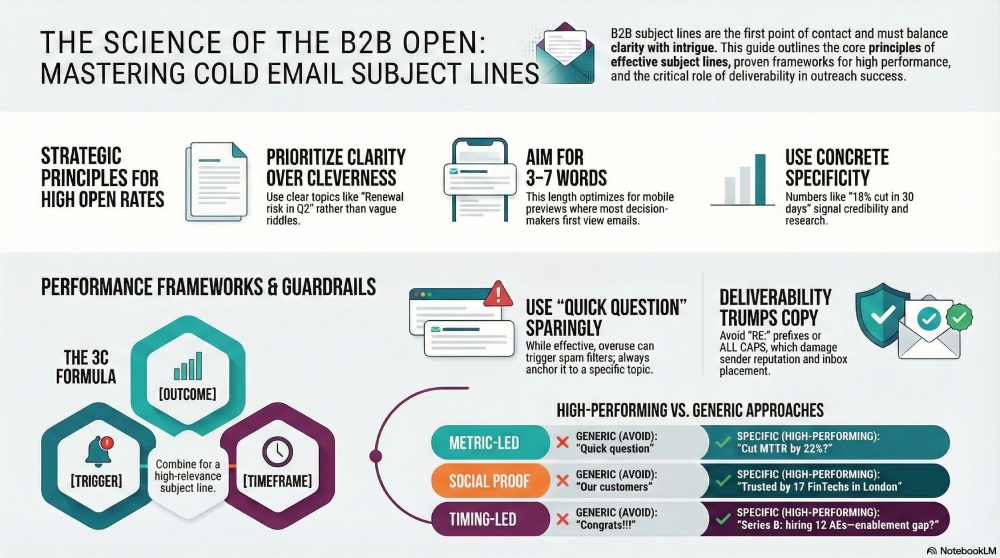
Tie cold email subject lines to public signals: a hiring burst on X, a funding round, a new integration launch, or a board appointment. Obama’s fundraising emails famously tested ultra-simple subjects like “Hey” to match moment and audience; that doesn’t port 1:1 to B2B, but the trigger-led timing does. When testing subject lines around news, avoid the SPAMMY “Congrats!!!” and use specifics instead: “Series B: hiring 12 AEs—enablement gap?”
Buying stage and email sequence
Early stage: emphasize curiosity and relevance, not a hard call offer. Mid stage: reference prior touch, a micro-case study, or a scheduled event to prime sales calls. Late stage: a clear subject line tied to decision criteria. Across the email sequence, keep context tight so the receiver recognizes continuity and is more likely to move on your ask.

Core principles of effective B2B subject lines: clarity, relevance, brevity, specificity, credibility
Principles outlast hacks. The best subject lines consistently score on five dimensions.
Clarity over cleverness
- What to favor: a clear subject line that names the topic (“Renewal risk in Q2”), not a riddle.
- What to avoid: the overly clever subject line that hides the value proposition.
- Creative subject line is fine—if it still communicates value.
Anti-patterns to skip
- The generic subject line: “Opportunity” or “Touching base” without context.
- Overused patterns: “Quick question” and “{First name}, thoughts?” with no tie to the receiver’s role.
- SPAMMY bait: “Urgent!!!” or “RE:” when it’s not a reply.
Relevance and specificity
Name the pain, metric, or tool the prospect already uses. Specificity signals a reputable sender who did their homework, which improves deliverability via downstream positive engagement.
Make it concrete
- “Snowflake spend: 18% cut in 30 days”
- “ADA fixes: Shopify PDPs in 72 hrs”
Brevity that preserves meaning
Shorter subject lines often fit mobile previews and lift open rate, but don’t overthink length at the cost of clarity. If trimming removes the value proposition, keep the extra word.
Credibility and social proof
Credibility can be woven into cold email subject lines lightly:
- “Trusted by 17 FinTechs in London”
- “Webinar with Katie Thies + Mary Grace D.”
Name-dropping real experts (e.g., Federico Donatone, Aviv Joseph Glazer, Dominique Michel, Taylor Haren, Benjamin C. Greeley) works only if it’s truthful. Empty-name stuffing reads generic and can trigger spam filters.
Data-backed best practices: ideal length, word choice, capitalization, numbers, emojis, punctuation
- Ideal length: 3–7 words often performs well on mobile. That said, deliverability over subject lines: prioritize sending practices that keep you in the primary inbox. If a slightly longer line is clearer, use it.
- Word choice: Actionable, concrete nouns and numbers tend to be performing subject lines. Example: “Cut MTTR by 22%.”
- Capitalization: Use sentence case. ALL CAPS looks SPAMMY and can tank open rates.
- Numbers: Quantify outcomes (“12 demos in 10 days”) to move the needle.
- Emojis: Rarely needed in B2B. If your prospects use them on LinkedIn or Facebook, a single tasteful emoji might fit; test sparingly.
- Punctuation: Avoid multiple exclamation points or fake reply prefixes. Excess punctuation screams spam.
Compliance footers (User Agreement, Privacy Policy, Cookie Policy) don’t affect open rate directly, but they support sender reputation and help with landing in inbox over time.
Personalization that scales: firmographic cues, role-based angles, social proof, timely triggers
Personalization is more than “Hi {First name}.” It’s context, at scale.
Firmographic and role-based angles
- Firmographics: industry, headcount, tool stack. Example cold email subject lines: “Shopify Plus: 3% AOV lift in PDP,” or “HubSpot–Salesforce sync: 4 errors we fixed.”
- Role-based: Speak to goals. For CS leaders: “Renewals: reduce ‘no-shows’ on sales calls.” For Demand Gen: “Cut CPL 28% without new spend.”
This level of personalization helps you look like a reputable sender, improves deliverability, and keeps you in the primary inbox across the sequence.
Social proof without exaggeration
Referencing third-party credibility works: “Case study: how we ‘crushed it’ for a Series B HRIS.” Don’t fabricate. If you cite Obama fundraising emails as inspiration, explain the context and why B2B differs. When you reference community experiments (e.g., from LinkedIn comments by peers like Mary Grace D. or Taylor Haren), describe the setup, not just the outcome.
Timely triggers and micro-hooks
Use timely triggers sourced from LinkedIn, X, press releases, or product changelogs:
- “G2 Fall badges: how to turn them into sales calls”
- “GA4 migration: attribution gap we’re seeing”
Tie triggers to a light call offer later in-body; the subject line should feel like a helpful heads-up, not a pushy pitch.
Testing that actually informs strategy
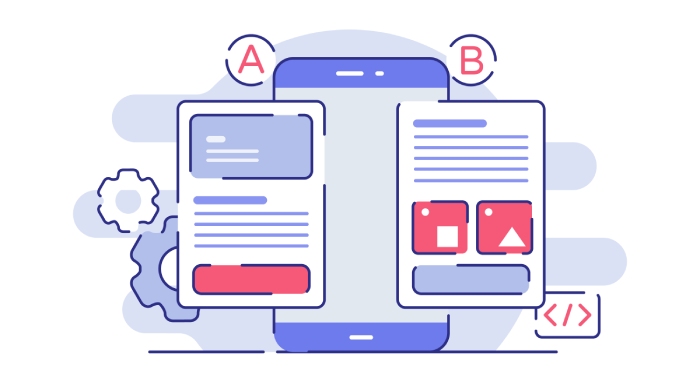
A/B testing subject lines is essential, but design matters:
- Split test hypotheses, not synonyms. Example: metric-led vs. trigger-led lines.
- Sample size: Wait for statistically directional data before you move on; don’t let the testing impulse lead to random changes that overfit a tiny send.
- Guardrails: Avoid risky patterns that hurt sender reputation while you A/B test. Protect domain reputation first.
In practice, run A/B testing weekly across your email sequence. Label each A/B test with the hypothesis and log outcomes. Over time, you’ll learn whether “Quick question,” “{First name}, thoughts?,” or role-specific lines are actually influencing open rate for your prospects.
Practical examples and when to use them
- “Quick question: RevOps handoff time?” Use when emails segue to short sales calls about a specific process gap.
- “{First name}, thoughts? on Q4 pipeline math” Use when replying to a prior thread or referencing a forecast artifact.
- “15-min call Friday? Cut SDR no-shows 19%” A clear subject line with a modest call offer—best after value has been established.
Be cautious: “Quick question” and “{First name}, thoughts?” can work in some client campaigns, but deployed blindly they read as a generic subject line and may push spam filters. Always anchor to context and value proposition.
Final guardrails to protect deliverability
- Warm gradually to maintain sender reputation and stay in the primary inbox.
- Targeting beats tricks: precise email targeting and relevance outperform any clever subject line.
- If a tactic risks spam complaints, deprioritize it. Protecting deliverability over subject lines is the smarter decision.
Remember, you’re writing for a busy receiver. Don’t overthink every variable; commit to best practices, keep testing subject lines with disciplined split test design, and let the creative juices flow within those constraints. When a line doesn’t perform, learn, iterate, and try again—then move on.
High-performing frameworks and formulas with mini-templates
Designing high-performing cold email subject lines starts with repeatable frameworks that respect context, prioritize deliverability, and simplify the receiver decision to open an email. Below are reliable structures you can adapt across client campaigns, with mini-templates and notes on when each framework will move the needle.
The 3C Framework: Clarity, Context, Credibility
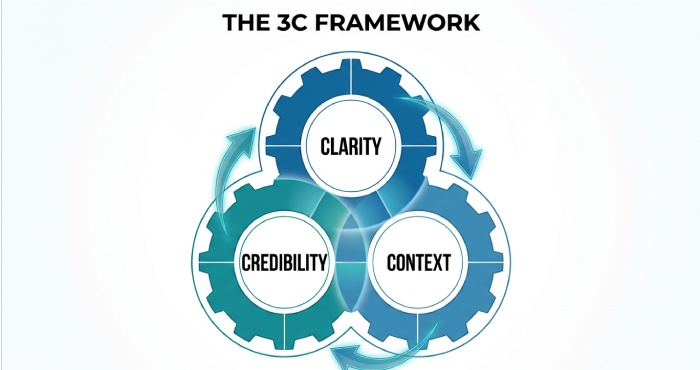
A compelling subject line should be clear, contextual to the receiver, and signal credibility fast. Shorter subject lines often outperform when email targeting is tight and your value proposition is obvious.
Formula: [Trigger] + [Outcome] + [Timeframe]
- Examples:
- “Missed Q4 pipeline? 12% lift in 30 days”
- “SOC2 prep: 2 weeks faster for fintech teams”
- “Cut cloud costs 18% this quarter?”
Why it works: it influences open rate by promising an outcome. Keep it a clear subject line; avoid a clever subject line if the context is unfamiliar.
Mini-templates
- “{Company} → {Metric} in {Time}?”
- “{Tool} costs: down by {X%} at {Peer}”
- “{First name}, reduce {Pain} without a new platform?”
Katie Thies and Mary Grace D. have shared on LinkedIn that simple, clear formulations like these have crushed it in client campaigns, especially when paired with a succinct call offer in the preview text.
The Question Hook (used responsibly)
Question-based cold email subject lines spark curiosity without sounding SPAMMY.
Using “Quick question” without tanking open rates
- “Quick question: {team}’s RevOps ops stack”
- “Quick question on your QBR metrics”
- “Quick Question about your RFP timeline” (note the capitalization variation seen in Obama fundraising emails)
Use sparingly. Overuse of “Quick question” can feel generic and tank open rates; anchor it to a specific topic to remain a reputable sender.
Variations: “{First name}, thoughts?”
- “{First name}, thoughts? on migrating off {Vendor}”
- “{First name}, thoughts? V2 of your pricing page”
- “{First name}, thoughts? SDR ramp time”
These perform as compelling subject line options when your targeting is tight and Nureply preview text reinforces the value proposition.
Social Proof + Specificity
Prospects decide quickly. Social proof helps the receiver open an email without overthink.
Numbers and namedrops
- “How {Peer} booked 37% more sales calls”
- “LinkedIn pipeline from comments: 3 plays that worked”
- “From webinar to sales calls: what Taylor Haren did differently”
As Federico Donatone, Aviv Joseph Glazer, Dominique Michel, Benjamin C. Greeley, and Taylor Haren have noted in LinkedIn comments, performing subject lines use specific proof and avoid a generic subject line. Cite credible sources (e.g., Obama fundraising emails’ minimalism) and align preview text to the claim.
Scenario-based examples: first touch, value-led, problem-led, referral/intro, event/webinar follow-up, break-up
First touch
- “{First name}, thoughts? on {KPI} this quarter”
- “Quick question: {tooling} consolidation”
- “{Company} ← 12% more qualified demos?”
Use when email targeting is precise. Keep it a shorter subject line; let the preview text carry the call offer.
Value-led
- “Playbook: 3 steps to lift SDR-sourced sales calls”
- “Free teardown: your {page}—what we’d fix”
- “Benchmark: {industry} reply rates vs. open rate norms”
Here, the compelling subject line signals immediate value; a creative subject line is fine if it stays clear.
Problem-led
- “Losing MQLs at handoff?”
- “Data decay is hitting your forecasts”
- “Ops backlog slowing sales calls?”
Problem-led cold email subject lines work when context shows you understand the receiver’s world.
Referral/intro
- “Intro from {mutual}”
- “{Coworker} at {Company} suggested a chat”
- “{Friend} thought this might help”
Avoid misleading “RE/FW”. If referred, name the coworker or friend plainly and link the call offer to that context.
Event/webinar follow-up
- “From {Event}: slides + one idea”
- “{Webinar} takeaway: fix {bottleneck} in 14 days”
- “Met via LinkedIn/X—follow-up on your question”
Mention platform context (LinkedIn, Facebook, X) so your message lands in the primary inbox with familiarity and better inbox placement.
Break-up
- “Close the loop?”
- “Worth parking until Q3?”
- “Move on for now?”
A clear subject line that lets both sides move on can earn respect and preserve sender reputation for later sequences.

Testing and optimization: A/B test design, sequencing, metrics, sample size, iteration cadence
A/B test design
Isolate one variable in A/B testing: subject line length, question vs statement, or specificity. Avoid testing impulse by changing multiple elements at once. Document a hypothesis, e.g., “Question format will lift open rate 8% with the same preview text.”
Variable control and split test hygiene
- Run a clean split test across the same segment and at the same send time.
- Keep content body, from name, and preview text constant.
- In an A/B test, avoid sending during holidays that skew behavior.
Sample size and stats
Aim for 300–500 opens per variant to reduce false positives. If your list is small, iterate across the email sequence, not just a single send.
Minimum sample guidelines
- B2B niche: 150–250 contacts per variant across 2 sends.
- High-volume: 1,000+ per variant for tighter confidence.
Sequencing and iteration cadence
Test subject lines across a 3–5 touch sequence: one “Quick question,” one value-led, one problem-led, one social proof, one break-up. Iterate weekly; retire underperformers quickly and move on to your next split test.
Metrics that matter
- Primary metric: open rate, but only after deliverability checks.
- Secondary: reply rate, positive reply rate, and sales calls booked.
- Diagnostic: inbox placement and spam complaints.
Remember: prioritize deliverability over subject lines. If you’re not landing in inbox, no subject line will influence open rate.

Deliverability and compliance: spam triggers, symbols, preview text synergy, legal/ethics in cold outreach
Avoid spam triggers and symbols
Minimize ALL CAPS, excessive exclamation marks, or SPAMMY symbols like $$$. Never ask for bank account details; that’s classic spam. Emoji sparingly; test them because they can tank open rates with certain receivers.
SPAMMY patterns to avoid
- “RE:” or “FW:” when no prior thread
- Overpromising (e.g., “guaranteed!”)
- Too many links in the body
Inbox placement and the primary inbox
Sender reputation and domain reputation drive landing in inbox more than clever copy. Warm up domains, send at steady volume, and keep complaint rates low. A reputable sender with consistent engagement will reach the primary inbox more reliably than the “best subject lines” alone.
Strengthen sender reputation
- Use real identity cues: a recognizable from name and a professional photo of sender.
- Keep lists clean; remove hard bounces and unengaged prospects.
- Reference social presence (LinkedIn) for credibility.
Preview text synergy
Your preview text should complete the compelling subject line and set expectation:
- Subject: “Quick question: rev org structure”
- Preview: “30-second idea; if helpful, share a time—no attachment.”
This alignment helps the receiver decision to open an email without confusion.

Legal and ethics
Honor regional laws and best practices: accurate sender info, easy opt-out, truthful claims. Link to your User Agreement, Privacy Policy, and Cookie Policy on your site when appropriate. Don’t impersonate a coworker or friend, don’t mislead with “RE/FW,” and never scrape beyond what platforms (LinkedIn, Facebook, X) permit.
Mistakes to avoid (and fixes): clickbait, vagueness, false urgency, over-personalization, misleading “RE/FW”
Clickbait
- Problem: “You won’t believe this” may spike curiosity but harms sender reputation.
- Fix: Use a clear subject line tied to real value proposition; let creative juices flow in the body, not the header.
Vagueness and generic subject line
- Problem: “Meeting request” or “Touching base” is generic and easy to ignore.
- Fix: Specificity: “{First name}, thoughts? on cutting no-shows for sales calls.”
False urgency
- Problem: “URGENT: respond today” feels SPAMMY.
- Fix: Real deadlines tied to context: “Quick question before QBR Friday?”
Over-personalization
- Problem: Dropping too many specifics (or a random photo reference) feels creepy.
- Fix: Personalize to role and current priorities. Use targeting and context, not trivia.
Misleading “RE/FW”
- Problem: Pretending there’s a prior thread is deceptive and can tank open rates long-term.
- Fix: Earn the open with performing subject lines; reputation compounds when you’re a reputable sender.
Overthinking and overtesting
- Problem: You overthink the perfect clever subject line and stall. Or you run four variants in one split test.
- Fix: Keep testing subject lines simple. One variable per A/B testing cycle; when the data is clear, move on.

FAQs
Should I use “Quick question” in my subject line?
Use it sparingly and always anchor it to a specific topic. Overuse can feel generic and hurt open rate, but a targeted “Quick question: {topic}” can work in a first touch.
Are shorter subject lines always better?
Shorter subject lines often help on mobile and in the primary inbox, but clarity beats brevity. Test both with an A/B test to see what your prospects respond to.
How many variants should I include in A/B testing?
Limit to two variants per split test to isolate variables. Run iterative A/B testing across your email sequence rather than bloating a single send.
What metrics should I watch besides open rate?
Track inbox placement, reply rate, positive reply rate, and sales calls booked. If deliverability drops, fix that first before judging subject line performance.
Do emojis or symbols hurt deliverability?
Sometimes. Emojis and excessive punctuation can trigger spam filters for certain receivers. Test them cautiously and monitor sender reputation.
How do I keep compliant with cold outreach laws?
Use accurate sender info, honest subject lines, and easy opt-out options in every initial and follow-up email. Link to your User Agreement, Privacy Policy, and Cookie Policy when relevant, and follow platform terms on LinkedIn, Facebook, and X.
What if my cold email subject lines stop working?
Retire them and iterate. Refresh with problem-led or social proof angles, and run a clean A/B test while checking domain reputation and list health.
Key Takeaways
- Clear, specific, and contextual subject lines outperform generic subject lines; pair them with strong preview text and a relevant call offer.
- Treat deliverability and sender reputation as foundations; without landing in inbox and the primary inbox, no subject line can influence open rate.
- Run disciplined A/B testing with one variable per split test, adequate sample sizes, and weekly iteration across your sequence.
- Use “Quick question” and “{First name}, thoughts?” selectively and with context; avoid misleading “RE/FW,” clickbait, and false urgency.
- Targeting and value proposition matter more than cleverness; optimize email targeting, keep lists clean, and focus on booking qualified sales calls.