
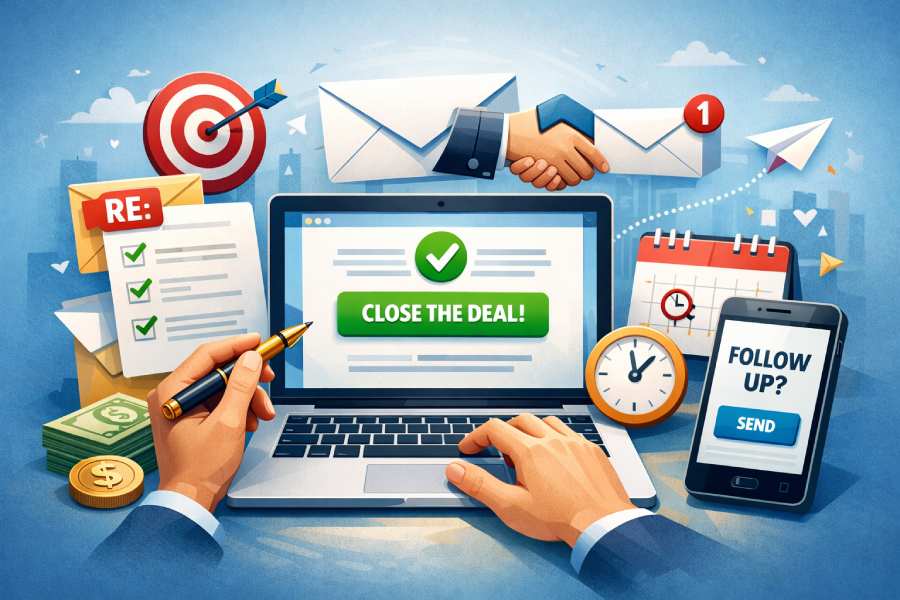
How To Close The Sale Via Email: Subject Lines, CTAs, And Follow-Ups
Closing a sale via email isn’t about sounding pushy or flooding inboxes—it’s about timing, clarity, and confidence. From the moment your subject line appears, you’re either earning a click or losing attention. Once opened, your message needs a clear call-to-action that feels natural, not forced, and follow-ups that add value instead of pressure. When done right, email becomes a quiet but powerful closer—guiding prospects from interest to decision with relevance, trust, and just the right nudge at the right time.
What “closing via email” really means (goals, buying-stage fit, readiness signals)
Define the goal of closing a deal in the inbox
To close a sale via email is to move a qualified buyer from intent to decision using a concise, decision-focused sales email. The aim is deal closure, not discovery: confirm fit, present a clear value proposition, and propose the next step that seals the deal. In practice, your sales closing email should compress clarity and trust into a few scannable paragraphs that drive action and drive results.
Fit the message to the buying stage
Effective closing techniques align with buyer intent. If your contact is still in lead qualification, you’ll nurture a lead; if they’re in the sales funnel’s decision stage, you’ll focus on sales closing. Signals that it’s time to close a sale via email include:
- They asked for pricing or contract terms.
- They involved a decision-maker or procurement.
- They compared you against alternatives.
- They engaged with late-stage content (case studies, ROI calculators) in your email outreach or on LinkedIn and HubSpot-tracked pages.

When these readiness signals show momentum in sales, a sales process email can responsibly create urgency and offer a specific call to action.
What success looks like
A strong close doesn’t always mean immediate payment. It can be to schedule a call, approve a proposal, or complete an appointment setting. The thread through all closing techniques is a single, unmistakable next step that increases conversion and response rate while maintaining clarity and urgency.
Decision-stage subject lines that earn the open (frameworks, personalization, urgency)
Use a proven framework: clarity, direction, urgency
Decision-stage subject lines perform when they deliver clarity and trust plus direction. Try this formula:
- Clarity: Name the outcome or value proposition.
- Direction: Indicate the next step.
- Urgency: Add ethical timing.
Email closing examples (subject lines):
- “Finalize your 28% cost reduction plan — contract ready by Friday?”
- “Approval to proceed: pilot start date and access details”
- “Shall we schedule a call to finish the rollout this week?”
These create urgency without pressure and align with buyer intent.
Personalize with context that proves relevance
Personalization that proves you did the work will get a response:
- “Q3 event marketing support for [Company]: venues + ROI forecast”
- “[Name], ready to launch your Outsourced SDR pilot for North America?”
- “ABM shortlist and next step for [ICP]: 3 B2B opportunities”
Reference recent activity on LinkedIn, Twitter, Facebook, Threads, or WhatsApp when appropriate: “Saw your product launch on LinkedIn—congrats. Would Tuesday work to schedule a call and finalize enablement?”

Borrow social proof in the subject line
Add proof or brand anchors to build rapport:
- “Case study inside: SMBs in Europe cutting CAC 21%”
- “Callbox Inc x [Company]: appointment setting timeline”
- “HubSpot integration + Callbox Channel Partner Program: ready to seal the deal?”
These email closing examples set direction and prime recipient engagement before your message even begins.
The anatomy of a high-converting closing email (structure, scannability, mobile-first)
Structure built for decision-making
A closing a deal message should be a craft a compelling email built for speed:
1) Hook: One-line recap of the business pain and your value proposition.
2) Proof: One crisp result (customer success, ROI, reference).
3) Plan: The next step in one sentence.
4) CTA: One button or link that’s unmistakable.
5) Friction removal: Address the biggest objection in a line.
6) Professional email closing: Your name, direct phone, calendar link.
Example skeleton (closing email lines emphasized):
- Hook: “As discussed, we’ll reduce no-show rates 31% with ABM + Event Marketing Services.”
- Proof: “SMBs and Startups across North America and Asia-Pacific achieved similar gains.”
- Plan: “We’ll kick off with a 30-day pilot.”
- Call to action: “Schedule a call to finalize access and start Monday.”
- Friction removal: “If procurement needs a shorter term, we can start with 15 days.”
- Professional email closing: “Best, [Name]—mobile, calendar, WhatsApp.”
This sales pitch email format helps you close a sale via email without ambiguity.
Scannability that drives action
- Use short paragraphs and icon bullets.
- Front-load numbers and outcomes to reinforce value.
- Make closing email lines and buttons visually prominent.
Your email closing lines are the last thing the reader sees, so make them motivational closing lines that leave a lasting impression and drive action. Keep the final impression tight: a personalized email closing, not a wall of links.
Mobile-first conventions
- 3–5 lines before any fold.
- Buttons at least 44px high.
- Short subject + preheader harmony.
- Direct calendar link for immediate reply to email.
End a sales email with a professional email closing that includes a direct phone and a calendar—small touches that create connection and clarity.
Crafting CTAs that drive a single, clear next step (scheduling, checkout, option framing)
One decision, one call to action
Every call to action email should ask for just one next step. Overchoice kills momentum. Strong CTA verbs include:
- Schedule a call
- Approve the proposal
- Start your pilot
- Complete checkout
To close a sale via email efficiently, place one call to action near the top and repeat it in your closing email lines for a memorable final impression.
Scheduling CTAs: remove friction
For appointment setting, embed a calendar snippet with two or three time options. Example call to action:
- “Schedule a call: Tue 10:00, Wed 14:00, Thu 16:30”
This increases conversion and helps you get a response from busy buyers.
Checkout and option framing
For product-led or low-ACV offers:
- “Start 14-day pilot — no card”
- “Choose your plan: Starter for SMBs or Growth for B2B opportunities”
Option framing can reinforce value by presenting a “good, better, best” decision without derailing deal closure.
Reinforce value around the CTA
Surround your CTA with 1–2 bullets that reinforce value:
- “ABM + lead generation to fill late-funnel demos”
- “Outsourced SDR to scale pipeline in Southeast Asia and Latin America”
This subtle repetition helps nurture a lead while keeping the focus on sales closing.
Handling objections with proof and risk reversal (price, timing, authority, guarantees)
Price: anchor ROI, not discounts
When price surfaces, reinforce value and outcomes:
- “Teams in Europe reduced CPL 18% using Account-based Marketing + Event Marketing.”
- “Qualified business sales leads increased 32% with a blended SDR + email sales strategy.”
If needed, offer a pilot or milestone billing. This is effective closing without eroding margins and helps seal the deal by lowering perceived risk.
Timing: preserve momentum in sales
If timing is the barrier, propose a phased plan:
- “Kick off with discovery this week; launch the campaign next week.”
- “We can secure event marketing inventory now and start outreach next month.”
Follow with a follow up email that recaps decisions, adds clarity, direction urgency, and includes concise closing email lines like “Can we confirm Thursday?”
Authority: ease internal buy-in
Provide assets decision-makers expect:
- 1-pager on value proposition and lead generation process
- Security overview and HubSpot/CRM integrations
- Reference calls from similar SMBs or Startups
Include social proof from Callbox, Jude Neilson content highlights, or Callbox Inc case studies across North America and Asia-Pacific. That credibility helps build rapport and advance client acquisition.
Guarantees and risk reversal: reduce friction
Offer assurances that drive action:
- Implementation guarantees (e.g., “Go-live in 5 business days”)
- Flexible terms (monthly to start)
- Performance checkpoints tied to B2B lead generation milestones
State these in your sales email and reiterate them in your professional email closing so the final impression is one of clarity and trust.
Follow-up cadence that maintains recipient engagement
Not every contact will reply to email on the first pass. Use a short follow up email sequence:
1) Day 2: “Quick nudge—shall we schedule a call for 20 minutes?”
2) Day 5: “Two options to proceed: pilot on Monday or a 15-min Q&A.”
3) Day 9: “Closing the loop if priorities shifted—happy to revisit next quarter.”
Each message should:
- Reiterate the value proposition in one line.
- Offer one call to action.
- Use email closing lines that are respectful and concise to leave a lasting impression.
Example objection-handling close
Email closing examples (body snippets):
- Price: “To reinforce value, similar ABM programs produced 5.4x ROI. If helpful, we can start with a 30-day pilot. Schedule a call to finalize the SOW?”
- Timing: “If the quarter is tight, we’ll start with lead qualification only, then expand to full appointment setting. Would Wednesday 14:00 work to seal the deal?”
- Authority: “Attaching a security brief and two references. Shall I loop in procurement, or would you prefer I send the summary deck first?”
These closing a deal snippets keep the ask simple, use motivational closing lines sparingly, and end a sales email with a professional email closing that becomes the last thing the reader sees—and remembers.
Notes on entities and channels:
- For multi-region rollouts (North America, Southeast Asia, Latin America, Europe, Asia-Pacific), highlight Callbox Event Marketing Services and Account-based Marketing alongside an Outsourced Sales Development Representative(SDR) model.
- If partnerships matter, mention the Callbox Channel Partner Program for co-selling and shared customer success.
- Social touches across LinkedIn, Twitter, Facebook, Threads, and WhatsApp can create connections before you close a sale via email—just one or two signals to humanize the exchange.
Follow-up cadence that converts without nagging
Timing anchored to buyer intent
A follow up email should mirror the buyer’s clock, not yours. If your goal is to close a sale via email, anchor timing to engagement signals such as proposal views, site visits, and content downloads. This approach helps you build rapport, maintain momentum in sales, and align with buyer intent without sounding pushy. The right cadence also ensures your email closing lines support your value proposition and don’t overwhelm recipient engagement.
A practical pacing model
- Day 0: Send your summary sales email within 1–2 hours of a meeting to reinforce value and outline the next step and specific call to action.
- Day 2: A short nudge to schedule a call or confirm the timeline.
- Day 5: Share a relevant proof point to nurture a lead and drive action.
- Day 10: Offer options (call, quick Q&A, or a one-pager) to get a response.
This sequence is calibrated to create urgency without pressure. The professional email closing and closing email lines in each message should reflect clarity and trust so the last thing the reader sees is a confident path forward.
Sequence length and tapering
Most sales closing sequences that close a sale via email run 4–7 touches. Start closer together (48–72 hours), then taper to weekly. If you’ve had high prospect engagement (opened proposals, attended a demo), you can extend to 8–10 touches with value-rich content rather than repeating the same ask. In each touch, end a sales email with concise closing techniques and a clear call to action that makes it easy to reply to email and schedule a call.
When to switch channels
If email alone stalls, layer in light, respectful outreach on LinkedIn, Twitter, or WhatsApp, and echo the message via a short phone call. For certain SMBs and Startups in Southeast Asia and Latin America, Threads and Facebook messages may lift response rate. Cross-channel touches should reference your previous sales email so the prospect can easily connect context, which helps leave a lasting impression without over-contacting.
Breakup emails that leave doors open
A breakup follow up email should never burn bridges. Use motivational closing lines that reinforce value, offer to step back, and keep the door open. Your email closing lines can “seal the deal” later by positioning you as helpful, not pushy.
What a good breakup does
- Acknowledge priorities and timing.
- Offer a future check-in window.
- Provide a resource that continues to nurture a lead.
- Include a low-friction call to action (“Want me to close your file for now or check back in 60 days?”).
These are email closing examples that signal clarity direction urgency while maintaining professionalism.
Personalization and segmentation that matter at close
Account context with ABM discipline
At the closing stage, generic messaging kills conversion. Use Account-based Marketing data to tailor a sales pitch email: business drivers by region (North America, Europe, Asia-Pacific), industry benchmarks, and relevant use cases (Event Marketing Services or appointment setting). When you close a sale via email with specific account context, your value proposition feels immediate, relevant, and primed for deal closure.
Segment cues to use
- Role: CFOs need ROI clarity; Operations wants workflows; Sales leaders want B2B opportunities and B2B lead generation.
- Region: Data residency for Europe, localization for Southeast Asia, and growth narratives for Latin America.
- Size: SMBs need speed and adoption; Startups want scalability and client acquisition milestones.
Behavior triggers and lead qualification signals
Trigger-based follow ups outperform static sequences. If a prospect reopens a proposal, watches a demo, or forwards a sales email internally, trigger a timely call to action email within two hours. These signals accelerate lead qualification and help you craft a compelling email that meets buyer intent. This is where effective closing often happens, because you can reinforce value at the precise moment they’re evaluating.
Personalizing the professional email closing
Use a personalized email closing to create connection: reference their timeline, a pain they voiced, or the metric they own. Your professional email closing and closing email lines should restate the next step and leave a final impression of clarity and trust. Treat email closing lines as microcopy that can drive results—often, they’re the last thing the reader sees and the lever that gets a response.
Tools and light automation without losing the human touch
CRM, proposals, e-signature, and tracking
Keep the sales process email aligned with your CRM (e.g., HubSpot) so every follow-up email and CTA—including Nureply sequences where appropriate—is logged, timed, and informed by stage. Proposal and e-signature tools (with page-level tracking) show which sections your buyer cares about, enabling you to reinforce value in your closing email lines. Use light automation and Nureply workflows to send reminders, but always customize the professional email closing to maintain a human tone.
A minimal “close stack”
- CRM: HubSpot for deal stages, tasks, and reporting.
- Proposal: Track views, time on pricing, and comments.
- E-signature: Reduce friction at deal closure.
- Engagement: Email tracking with link-level alerts.
Using partners without losing authenticity
If you work with Callbox or Callbox Inc for Outsourced SDR or the Callbox Channel Partner Program, coordinate your email outreach with their team’s calls to maintain one narrative. This sync supports your email sales strategy, improves conversion, and protects the final impression. Attribution stays clear, and your call to action always points to one next step (typically to schedule a call).
Social touches that humanize
A timely LinkedIn note or a quick WhatsApp voice message can humanize a sales email thread. Keep social nudges brief and consistent with your email closing examples. These touches improve recipient engagement, build rapport, and can drive action when an inbox is crowded.

Measurement and optimization
KPIs that matter at close
Track response rate, meeting set rate, proposal to signature conversion, and time-to-deal closure. Monitor how often prospects schedule a call within 48 hours of your sales closing email. These KPIs inform which email closing lines, CTAs, and sequences truly seal the deal.
A/B testing at the edge
Test subject lines, call to action phrasing, and sequence order. A/B testing your closing techniques and call to action email variants will reveal which messages align with buyer intent. Iterate microcopy in your professional email closing to see which options get a response and drive results.
What to test specifically
- Subject lines that create urgency vs. curiosity.
- CTA placements: button vs. inline text.
- Closing email lines: direct ask vs. options.
- Time delays between steps.
Feedback loops that sharpen your message
Close the loop with customer success to understand onboarding friction and expand your value proposition with outcomes. Share wins and objections in weekly sales communication so the team can craft a compelling email that mirrors real-world proof. This rhythm improves lead generation quality and keeps the sales funnel healthy.

Templates and examples to use today
Subject lines that create urgency without pressure
- “[Name], ready to finalize the rollout this week?”
- “Shall I reserve your onboarding slot for Tuesday?”
- “One step left to seal the deal—want me to send the DocuSign?”
- “Quick check: do we still have the green light to schedule a call?”
These are simple email closing examples in subject form that can close a sale via email by signaling the next step and clarity direction urgency.
CTA copy that aligns with buyer intent
- “If you’re good with this, hit reply with ‘Go’ and I’ll send the agreement.”
- “Would a 15-minute review tomorrow help you make a confident decision?”
- “Choose one: A) Proceed, B) Need edits, C) Pause 30 days.”
Each call to action should reinforce value and end a sales email with options that drive action while leaving an impression of partnership.
A 3-email closing sequence
Below is a practical sequence you can adapt. Each sales email includes targeted closing email lines to nurture a lead and prompt a clear next step.
Email 1: recap value proposition and next step
Subject: Recap + the simplest path to launch
Body:
- Two-sentence recap of the pain and value proposition.
- 3 bullets with quantified outcomes (tie to qualified business sales leads, appointment setting, or Event Marketing Services).
- CTA: “Would you like me to reserve Thursday 10:30 AM for kickoff or send the agreement for review?”
- Professional email closing: “I can hold your spot and coordinate with onboarding in under 24 hours.”
This is an effective closing format that can close a sale via email by making the path obvious.
Email 2: social proof and call to action to schedule a call
Subject: 12-week outcomes from teams like yours
Body:
- One-liner case study (region-specific for North America or Europe).
- Short paragraph on Account-based Marketing or Outsourced SDR impact on client acquisition and B2B opportunities.
- CTA: “Open to a 12-minute review to finalize scope? If yes, I’ll send the calendar link.”
- Closing email lines: “If now isn’t ideal, say ‘next month’—I’ll adjust.”
This reinforces value and can seal the deal when timing is right.
Email 3: gentle breakup that still nurtures a lead
Subject: Should I close your file for now?
Body:
- Acknowledge competing priorities and offer a no-pressure out.
- Share a resource (HubSpot playbook or a Callbox case study).
- CTA: “Want me to circle back in 30–45 days, or would a 5-minute check-in this Friday help?”
- Professional email closing: “Either way, I’ll respect your timeline.”
This approach to closing a deal preserves the relationship and can trigger a later conversion.
P.S. line examples as the last thing the reader sees
- “P.S. If it helps, I can tailor your plan for Asia-Pacific expansion in 10 minutes.”
- “P.S. We’ve helped peers in the Southeast Asia ramp pipeline without extra headcount.”
- “P.S. Quick DM on LinkedIn works too if your inbox is packed.”
These P.S. lines are small, but as the last thing the reader sees, they can create connection, reinforce value, and leave a final impression that nudges a reply to email.
FAQs
How many follow ups are too many when trying to close a sale via email?
Aim for 4–7 touches, tapering over two to three weeks. Extend only if you’re adding new value and observing engagement signals like proposal views or replies.
What makes a professional email closing effective?
Restate the next step, time-bound the call to action, and reflect the buyer’s language. Keep closing email lines concise and focused on outcomes, not features.
Should I use automation for sales closing?
Yes—light automation for reminders and tracking is helpful, but personalize each sales email and professional email closing. Automation should support, not replace, human context.

What metrics indicate my sequence is working?
Monitor response rate, meetings booked, proposal-to-signature conversion, and time to deal closure. A rising schedule a call rate within 48 hours of a CTA is a strong signal.
How do I personalize at scale near close?
Segment by role, region, and behavior triggers. Reference specific pains and use personalized email closing lines that align with buyer intent and reinforce value.
When is a breakup follow up email appropriate?
Send a polite breakup after 2–3 unanswered touches post-proposal. Keep the door open, offer resources, and invite the prospect to choose a later re-engagement window.
Key Takeaways
- Tie follow up email timing to behavior triggers and keep each call to action specific and time-bound.
- Personalize account context and value proposition to align with buyer intent and reinforce value.
- Use light automation (CRM, proposals, e-signature) but craft a compelling email with a human, professional email closing.
- A/B test subject lines, CTAs, and closing email lines to lift response rate and conversion.
- Equip a 3-email closing sequence with social proof and options that nurture a lead and seal the deal.